10|Aristotle: Logic as the Grammar of Being
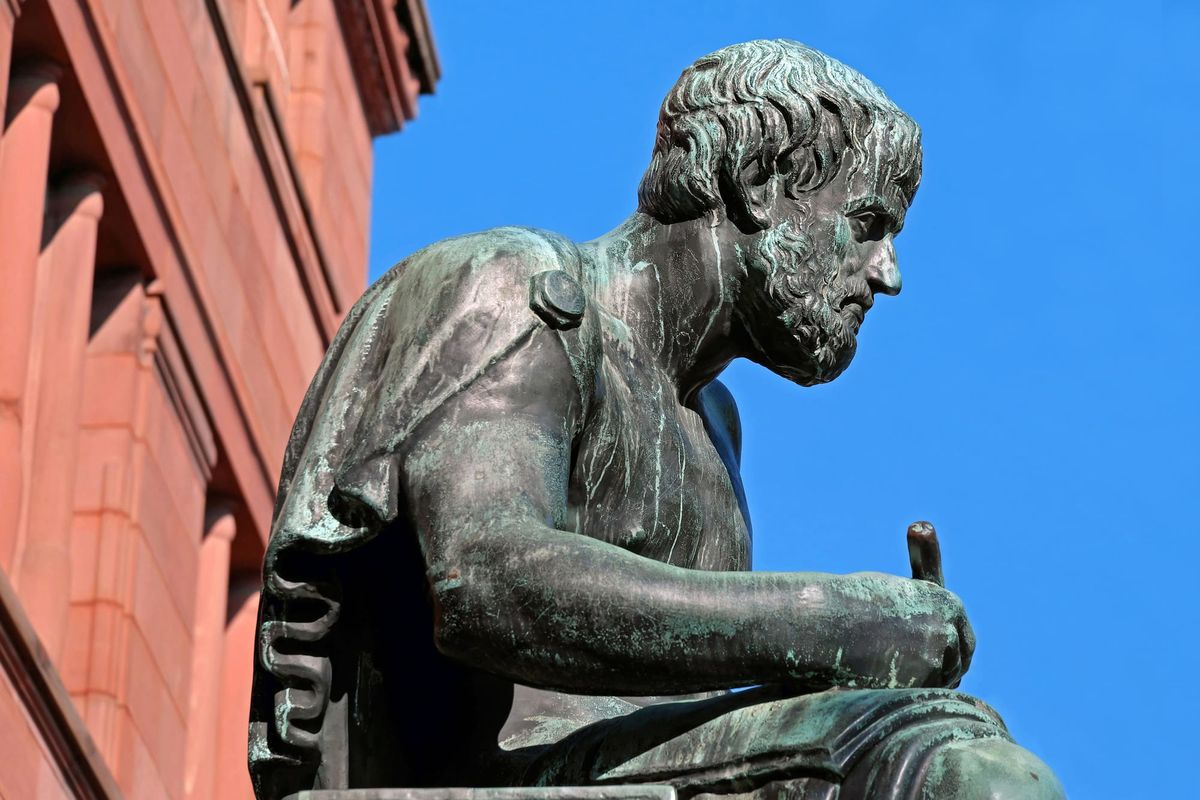
7.7.1 Aristotle: Logic as the Grammar of Being
Aristotle stands as the primary fountainhead of the entire Western rational tradition. This is no hyperbole: almost everything that has since been christened as "Science," "Philosophy," or "Reason" finds its warrant within his foundational judgments. That judgment may be distilled into a single, audacious creed: The world itself is accessible to the grasp of Reason.
Unlike Plato, Aristotle did not entomb Truth within a transcendent world of supersensible Forms. He acknowledged the necessity of Form, but refused to demote the material world to a mere shadow-play. Form, in the Aristotelian turn, ceased to be a remote ghost haunting a "Yonder" realm; it became the intelligible structure dwelling within the things themselves. By this shift, Reason was granted, for the first time, the sovereign right to look the world in the face.
The Emergence of Logic: From Object to the Machinery of Thought If the world is knowable, the question is no longer merely "What is the world?" but rather: "By what means do we know it?" Aristotle performed here a decisive relocation of the philosophical gaze. Philosophy ceased to merely stare at objects and began to examine the very pulse of Thought itself.
Thus, Logic was born. Logic was never a mere secondary craft; it was the systematic map of "how Thought must proceed to stay true." It concerned itself not with particular things, but with the formal relations between judgments, concepts, and inferences. For Aristotle, this study carried a profound ontological weight: if the world can be gripped by Thought, then the fundamental architecture of Thought must surely correspond to the architecture of Being. Logic, therefore, was not a subjective artifice; it was the rational form that unmasked the very Order of Existence.
The Foundational Weight of Logic This postulate birthed consequences that have shaped two millennia of thought:
- The Grid of Reason: Reason was provided with an unshakeable framework. The Law of Identity, the Law of Non-Contradiction, and the Law of the Excluded Middle were no longer treated as mere mental habits; they were seen as the irreducible conditions of all possible knowledge.
- The Birth of Epistemology: Philosophy began to reflect systematically upon itself, admitting that knowing is not a "natural" accident but depends upon an analyzable structure.
- The Warrant for Science: Logic provided the transcendental floor for mathematics and natural science—the common soil for all modeling, proof, and deduction.
- The Democratization of Reason: The fact that Logic could be learned meant that Reason was no longer a rare mystical gift but a tool that could be forged, taught, and replicated. In this, Aristotle inaugurated the Western tradition of "Pedagogical Reason."
The Unexamined Premise Yet, within this magnificent foundation, a vital question remained dormant. To what domain does Logic truly belong? If Logic studies Thought, it describes, first and foremost, the operational habits of human cognition. But Aristotle, in practice, made a far more radical assertion: he treated Logic as the very skeleton of Existence itself. The Law of Non-Contradiction was not merely "We cannot say A and Not-A at once"; it became "A thing cannot be A and Not-A at once." This translation is not a logical necessity; it is a metaphysical leap of faith.
The Tension Between Logic and Being From this, a long-veiled predicament emerges: are the laws of Logic truly the laws of Existence, or are they merely the stable structures formed by the human mind within the narrow confines of its own expression? In the coarse business of the world, this question does not hinder the efficacy of Reason. Logic guides our bridges, our laboratories, and our laws with commendable reliability. But reliability is not the same as ontological sufficiency. Does the perfection of Logic imply the perfection of Being? Does the necessity of the syllogism imply the necessity of the World? These questions were not yet audible in the halls of the Lyceum, yet they remain the most haunted of Aristotle’s legacies.
Summary: Foundation as Pre-supposition The majesty of Aristotle lies in his firm establishment of the faith that Reason can master the world, and in his provision of the logical scaffolding for that faith. But his premise was equally stark: that which is intelligible to Reason is identical to the structure of Being. This premise has buttressed two thousand years of thought, while silently dictating the very questions we are permitted to ask. Logic as the "Grammar of Being" is both the starting point of Western Reason and its earliest, most enduring metaphysical assumption.