19|Foucault: The Sovereignty of Discourse and the Manufacture of Knowledge
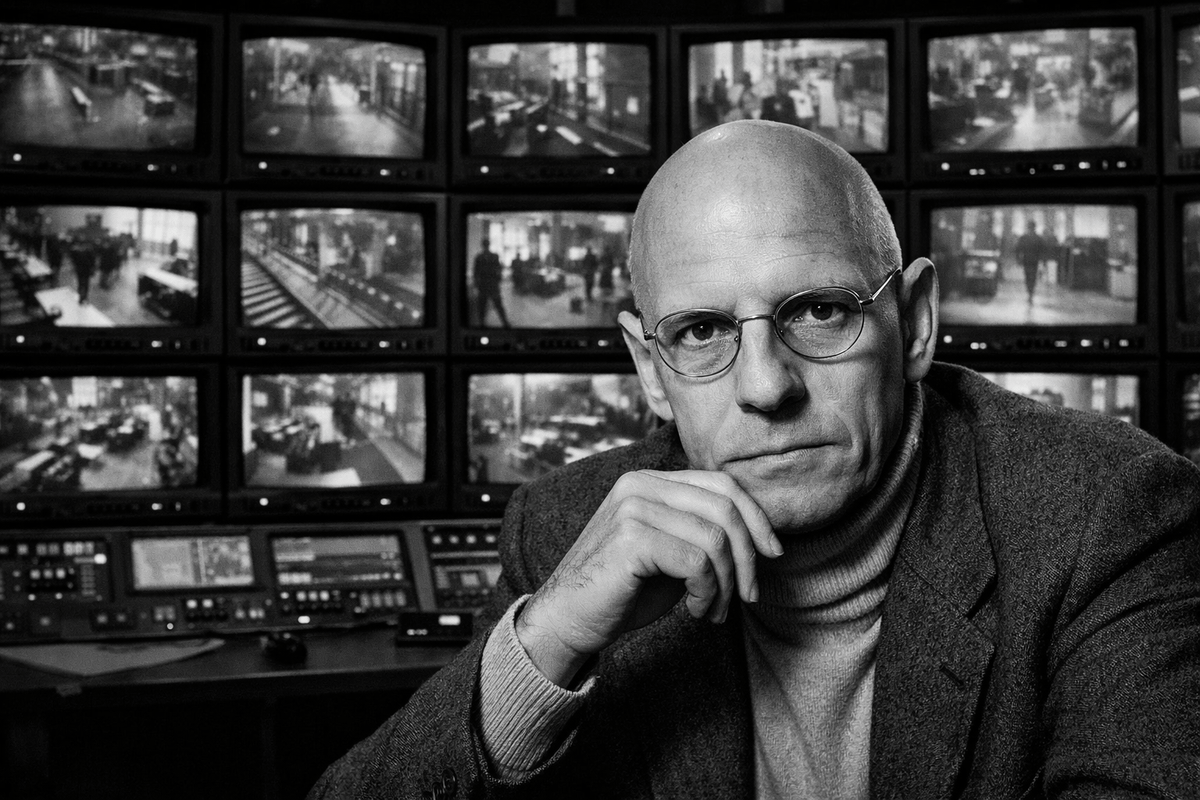
9.1 Foucault: The Sovereignty of Discourse and the Manufacture of Knowledge
In the philosophical lineage we have traced, a singular and relentless trajectory has emerged: from Plato to Hegel, the essence of the world was sought in the Idea; the grasp of the Idea depended upon Reason; and the machinery of Reason was eventually refined into Concept and Logic. When this edifice reached its zenith, the "Ideal World" was not merely a representation, but was declared the only Being accessible to the human intellect. In the works of Wittgenstein and Heidegger, this mode of cognition was explicitly identified as Language. Language ceased to be a neutral tool and became the singular, mandatory structure through which Man encounters Reality. Within this context, the arrival of Michel Foucault is no mere rupture; it is an inevitable extension of the linguistic siege.
Foucault did not confront "Language" as an abstraction, but rather in its concrete, materialized form within history: Discourse (discours). Discourse is not simple speech; it is:
- The institutionalized use of language.
- A system of concepts sanctioned, trained, and disseminated by authority.
- A structure of knowledge woven into the very fabric of Education, Medicine, Law, and Psychiatry.
Here, Language is stripped of its mask as a neutral medium; it is revealed as a Mechanism of Production.
I. From "Knowing the World" to "Manufacturing the Knowable" In Husserl, cognition centered upon the Subject: without the participation of the Subject, there was no perception. Foucault, however, performs a lethal inversion. He asks not, "How does the Subject know the object?" but rather: "How is the Subject itself manufactured by the structures of Knowledge?" In Foucault’s gaze, cognition is not a natural faculty, but a result of discipline, regulation, and filtration. We do not exist as "Subjects" prior to learning; rather, it is in the process of consuming sanctioned knowledge that we are meticulously sculpted into Subjects.
II. Discourse Dictates Knowledge; Knowledge Dictates Identity Foucault’s decree—that Discourse dictates Knowledge—is not a mere linguistic judgment; it is a judgment of Power. For:
- Knowledge is not naturally harvested.
- Concepts do not emerge in neutrality.
- Classifications are not spontaneous reflections of nature.
Every recognized field of knowledge is maintained by mechanisms of exclusion: the division between the Sane and the Insane, the Normal and the Abnormal, the Legitimate and the Forbidden. In this sense, Knowledge is the very operation of Power. Even more critically, Power does not merely oppress the Subject from without; it produces the Subject from within through the architecture of Knowledge.
III. The Captivity of Experience At this point, Foucault parts ways decisively with the British Empiricists. Locke and Hume believed that by returning to Experience, one could evade the fictions of Metaphysics and Language. Foucault retorts that Experience itself is systematically fabricated. We "experience" the world in a certain way not because the world is inherently so, but because we have been trained in how to feel, how to interpret, and how to describe. Experience is not the opposite of Linguistic Tyranny; it is often its ultimate extension into the very nerves and fibers of the body.
IV. The Consummation of Linguistic Tyranny Under Foucault, the tyranny of language is no longer limited to the realm of thought; it becomes an all-encompassing mechanism for the shaping of Existence. This tyranny manifests in:
- How concepts define the "Normal."
- How classifications generate "Deviance."
- How diagnosis manufactures "Identity."
Man does not merely accept a linguistic description; in the act of acceptance, he becomes the person described. Language and Knowledge are not merely explanations of the world; they are clandestine commands concerning how we are permitted to exist.
V. The Possibility of Escape: Practice in the Crevices Confronted by this closed circuit of Language-Knowledge-Power, Foucault did not retreat into Metaphysics. His response was the Practice of the Self within the fissures of Discourse. This entails:
- Refusing total identification with the identities bestowed upon us.
- Resisting the complete internalization of "normalized" self-understanding.
- Living out a practice of "Difference" in the zones where the system fails to reach. This is a resistance of action, not a transcendence of theory.
VI. The Unfinished Road: The Absence of a New Structure Yet, it is here that Foucault, too, stays his hand. He demonstrated that the Subject is manufactured by Knowledge, and Knowledge by Discourse. But he failed to ask the more dangerous question: If the "Self" is a product of Discourse, what new cognitive structure is required to sustain a different mode of existence? If we are to live "differently," it cannot be a mere strategic shift in behavior; it demands:
- A mode of understanding distinct from existing linguistic frames.
- A path of experience not dominated by the Concept-Logic apparatus.
- A level of perception outside the mechanisms of knowledge production.
This, Foucault did not provide.
VII. Summary: Exposing Power, Withholding the "Beyond" Foucault’s legacy is clear: he unmasked the power-form of Reason and Language in our reality. But his failure is equally stark: he did not explain how Man might know, feel, or house his existence outside the cage of Language. He dismantled the illusion of neutral speech but offered no cognitive path beyond the linguistic structure. Here, at this impasse, the whole of Post-Structuralism halts. And the question becomes inescapable: If Language is neither Truth nor the sole portal, how shall Man proceed in the "Beyond"?