60|The World as Representation
26.1 The World as Representation: The Structural Boundaries of Linguistic Cognition
—The Purest Prototype of "Epistemology After Language" in Philosophical History
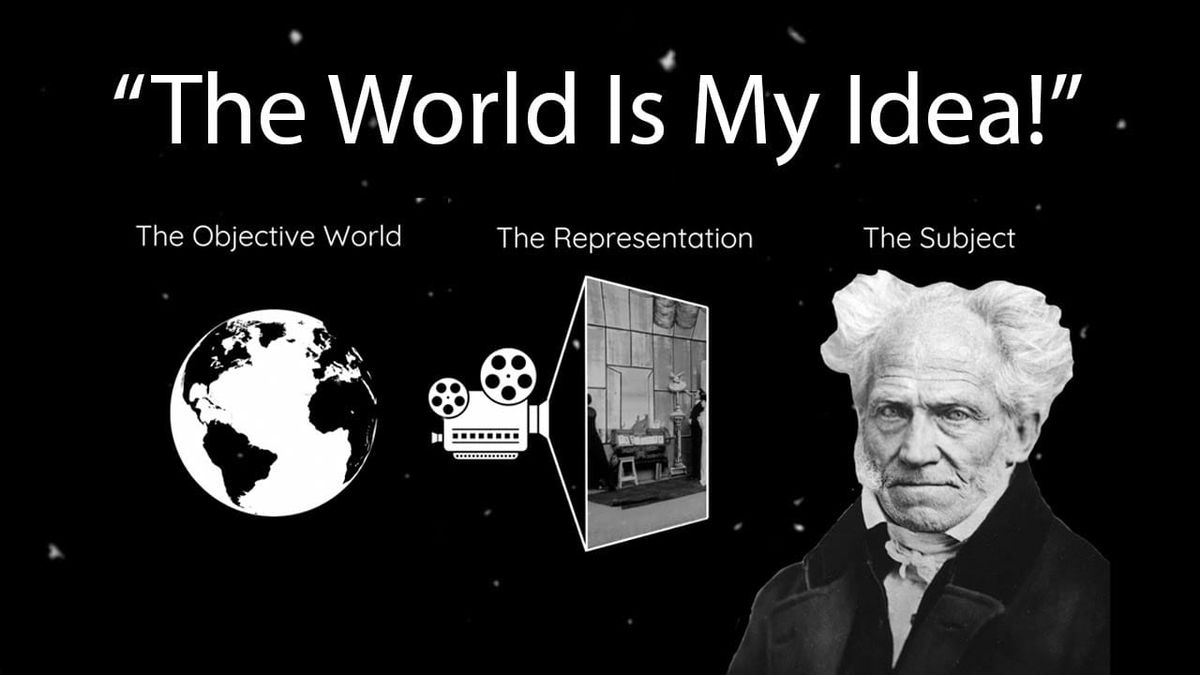
Schopenhauer’s philosophy opens with a sentence as concise as it is profound: "The world is my representation."
This is not a manifesto of subjective idealism, but a radical deepening of Kantian epistemology: everything we experience in the world has already undergone secondary processing by subjective and linguistic structures. Thus, Man eternally dwells within a "Presented World" rather than the "Real World." This insight constitutes the historical bedrock for what we define as the Boundary of Linguistic Cognition.
In Schopenhauer’s lexicon, "Representation" (Vorstellung) does not signify a mere "mental image"; it is a rigorous structural concept. For the world to manifest in an experiential, intelligible, and judicative form, it must satisfy four conditions:
- The presence of a Subject (experience must occur within a subjective horizon);
- Forms of perception and intuition (primarily Space and Time);
- Causality (events must be explainable);
- The intervention of Linguistic Structure (presentation must be nameable and categorizable).
In other words: Representation is the structural result of the Linguistic Mode acting upon the world. It is not the world itself, but the "Compression Layer" through which the world must pass before entering consciousness.
I. The Structural Determinism of Representation and the Opacity of Language Schopenhauer inherited and fortified Kant’s central verdict: we never behold the "Thing-in-Itself," only the "Thing as processed by consciousness." This processing is not optional; it is the transcendental framework of the mind:
- Spacetime grants the world "Externality" and "Sequence."
- Causality grants the world "Explainability."
- Language grants the world "Objectivity" and "Communicability."
Working in concert, these frameworks ensure we can never confirm whether the structure of experience belongs to the world or is merely imposed by consciousness to render the world intelligible. Schopenhauer’s contribution was to label this total structure Representation (Vorstellung), clearly noting that its primary function is not "falsification," but "Veiling." It veils the true countenance of the world by re-organizing all manifestation into nameable objects, describable relations, judicative propositions, and intelligible causal chains.
This mirrors our central critique of the Linguistic Mode: Language grants us Reason, but at the cost of our proximity to Truth.
II. Language as the Core Engine of the Representational Mechanism While Schopenhauer did not engage in an explicit critique of "Language," his entire system implies that Representation operates stably because Language continually reinforces it. Language serves as the four critical mechanisms of Representation:
- Objectification: Language must sever continuous manifestation into "things."
- Conceptual Primacy: Concepts act as filters for experience rather than its results.
- Causal Coercion: Every sentence forces experience into a "Because-Therefore" structure.
- Subject-Centricity: Every utterance presupposes the Subject as the center of judgment.
Representation is not a sensory illusion; it is a Linguistic Product. We believe we "see" the world, but we actually behold the world in the form that language permits consciousness to accommodate. This is why Schopenhauer says, "The world is my representation," rather than "The world is what I feel." He correctly identified that the boundaries of cognition are the boundaries of language.
III. The Enclosure of Representation as the "Gap" for Presence Schopenhauer’s theory of Representation accomplishes a vital philosophical task: it categorically denies the possibility of the Linguistic Mode ever reaching the Noumenon. He logically bifurcates the world into two strata:
- The World as Representation (The World of the Linguistic Mode);
- The World as Will/Noumenon (The Non-linguistic World).
He established a definitive rupture: the Linguistic Mode can never traverse the gap to the Noumenon. However, he stopped short of providing a systematized "Epistemology After Language." He merely pointed out that Representation is not the terminus; the Noumenon exists beyond the veil.
He left behind a "Gap," and it is upon this very gap that our theory of the Mode of Presence constructs a complete structural theory. Schopenhauer proved that to cognize Truth, we must not refine Language, but rather demand its Abdication. This provides the historical foundation for our core theses:
- Linguistic cognition is inherently finite (The Structure of Representation).
- The Noumenon can only manifest outside of Language.
Schopenhauer’s "Representation" is thus the historical prologue to the Mode of Presence.