75|The Archetypal Vessels of the After-Linguistic
29.4 | The Archetypal Vessels of the After-Linguistic: Poetry and Narrative
While the forms of linguistic art are manifold, if we adhere strictly to the five criteria proposed in the preceding section—the abdication of ego, immersion, independence from conceptual logic, the blurring of spacetime, and the evocation of collective affect—there exist but two linguistic forms that archetypally satisfy these requirements: Poetry and Narrative.
It is precisely for this reason that in the dawn of humanity, prior to the development of abstract logical speech, poetry and narrative served as the primary conduits for Truth, World, and Experience—witness the Homeric Epics or the vast narrative architecture of the Holy Scriptures. However, though literary history is replete with verse, much of it remains saturated with the poet’s potent will, philosophical posturing, and rational judgment. While such expressions possess value, they do not align with the characteristics of the "After-Linguistic."
Therefore, it is more precise to assert: Only Poetry and Narrative characterized by a descriptive structure and the abdication of the subject constitute the true linguistic forms "After Language."
4.1 Descriptive Poetry: The Primordial Mode Closest to Presence To illustrate this, we look to the most quintessential examples: the Chinese classical anthology, the Classic of Poetry (Shijing), and the Song of Solomon in the Western canon. The linguistic structures of these two are remarkably proximal, both presenting a pure form of primordial speech: Description over Explanation; Manifestation over Intention; Resonance over Declaration.
I. Why the Classic of Poetry is a "Ready-made Answer" The Shijing is the oldest collection of Chinese verse, yet these were not the deliberate compositions of philosophers but a gathering of ancient folk songs. Precisely because they lack "philosophical processing," their language remains natural and pure, preserving the primordial state of human speech.
In these verses, events are presented and emotions manifest, yet the Subject does not occupy the center. Consider the classic lines from The Moon Out: "The moon comes forth in her splendor; / How bright is she, the lovely lady! / With a slow and measured step, / How my heart is full of sorrow!"
Here, emotion (sorrow) appears, but the "I" does not dominate. The emotion is not repressed, yet the power of interpretation is not seized by the subject. Beauty and heart manifest within the relationship, rather than being possessed by the "Ego." This satisfies all our criteria: subjective abdication, descriptiveness, and the absence of logical adjudication.
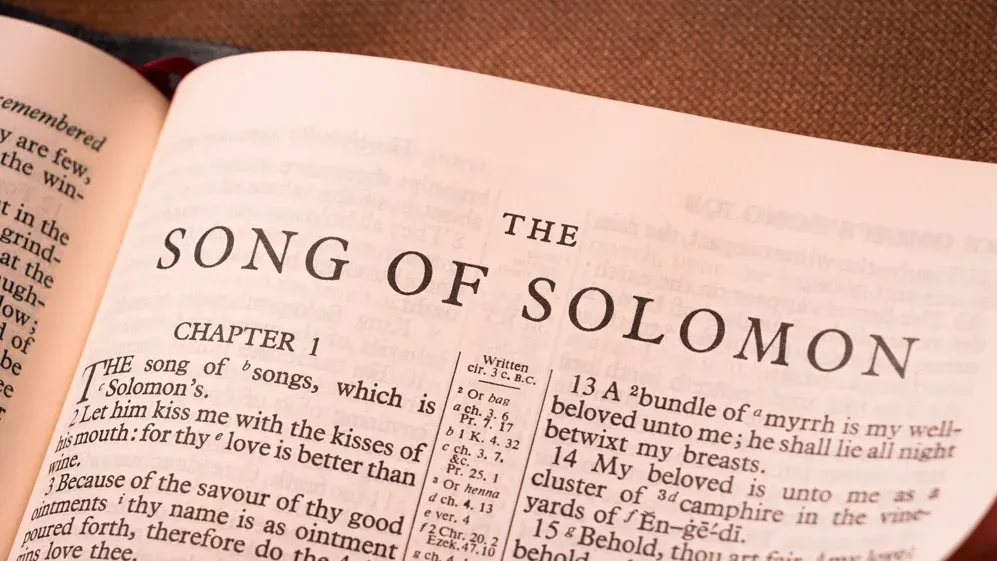
II. The Song of Solomon: Purest Presence in the Western Tradition In the Holy Bible, the Song of Solomon mirrors the style of the Shijing. It is neither theological exegesis nor ethical instruction, but a pure expression of Presence. Song of Solomon 1:15: "Behold, thou art fair, my love; behold, thou art fair; thou hast doves' eyes." There is no "I want you"; there is only "Thus you manifest." Song of Solomon 2:10–12: "Rise up, my love, my fair one, and come away. For, lo, the winter is past, the rain is over and gone; the flowers appear on the earth; the time of the singing of birds is come..." Time here is not calendrical, but an emotional manifestation of seasons.
III. Common Conclusions of East and West In both traditions, we observe a shared linguistic logic: the subject abdicates the right of interpretation; experience manifests holistically; beauty is placed there as a fact. Early poetry is the original form of the language "After Language." Its task was not to express an opinion, but to let "Presence" itself appear.
4.2 Narrative: The Communication of Truth in the Scriptures If Poetry is the linguistic rhythm closest to Presence, then Narrative is the primordial vessel for human experience and meaning. This is most vividly displayed in the Gospels—nearly all of Christ’s teachings were delivered through parables. Not through syllogisms or abstract concepts, but through "things that happened."
To sustain the task of Presence, a narrative must possess:
- Egofree-ness: The narrator recedes and does not seize the right of interpretation.
- Pure Descriptiveness: The story presents a situation; the event itself is the carrier of meaning.
- Interpretative Openness: It offers no explicit conclusion or "moral of the story," keeping meaning in a state of flux.
- Immersivity: It possesses a natural suction that draws the reader in without logical intervention.
Furthermore, Narrative possesses a vital property: it relies upon the "Breath" and "Rhythm" of the teller. In the Scriptures, Christ’s parables are truth-bearing because they were not merely read, but told. His posture, pauses, and gaze all participated in the manifestation of meaning. In short: Narrative communicates the state "After Language" because it requires both Word and Presence. The meaning is not stated; it is "shown."