0.4 | The Parable of the Talents: The Activation of the Source
0.4 | The Parable of the Talents: The Activation of the Source
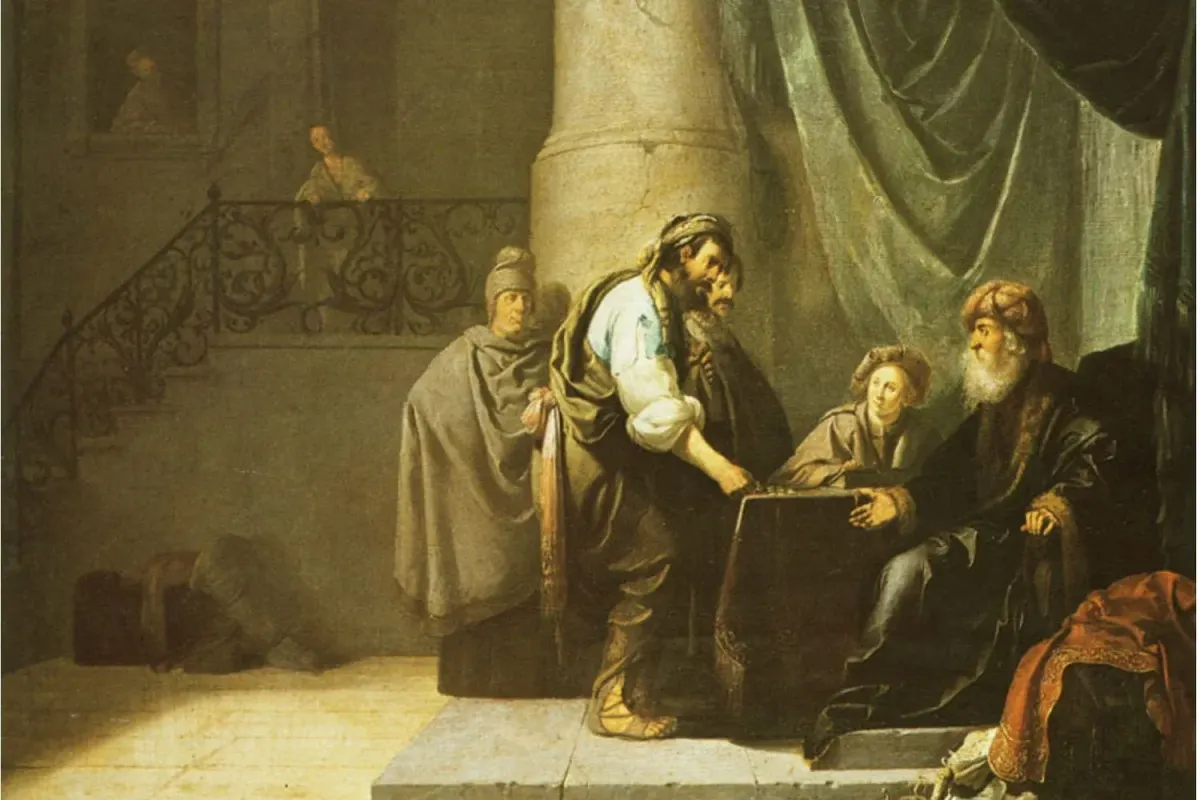
Before we proceed, we must offer a structurally precise recapitulation of this familiar parable. A master, departing for a far country, entrusts his property to three servants: to one he gives five talents, to another two, and to the third one—"each according to his ability." The master issues no manual of risk; he simply departs.
The first two servants immediately cast their entrusted substance into the currents of activity, doubling their charge. The third, however, chooses the path of the sepulcher. He neither squanders nor steals; he buries the talent to ensure it is "not lost." Upon the master's return, the first two are invited into "joy," while the third is severely rebuked and cast out. His sin was not dishonesty, but Structural Non-participation. Here, the Parable of the Talents closes the loop with the Manna and the Jubilee.
0.4.1 | The Burial of Potentiality In the logic of the Kingdom, the third servant is not accused of theft, but of Severing Connection. What he buried was not a piece of metal, but a possibility of use. From a systems perspective, a resource isolated from circulation is not preserved wealth; it is Excised Potential. The meaning of any resource is Relational rather than Possessive. A talent not committed to the network is functionally equivalent to a disconnected node. Whether it remains physically intact is irrelevant; economically, it has already ceased to exist. The judgment rendered is not an outburst of moral indignation, but a Structural Assessment: a node that refuses to transmit cannot remain part of a living system.
0.4.2 | Stagnation as the Ultimate Sin A second fallacy must be dispelled: that this parable praises risk-taking as an end in itself. In truth, the parable defines Stagnation as Failure. Within this framework, Risk is merely Transfer—wealth may shift from one holder to another, but it remains within the system. Destruction, however, resides uniquely in Stasis. The master’s harsh descriptors—"wicked and lazy"—are system-level judgments. "Lazy" denotes the refusal to invest effort into enabling turnover. "Wicked" denotes the parasitism of enjoying the system’s protection while refusing to participate in its generative process. The sin is not failing under uncertainty, but Choosing Non-circulation.
0.4.3 | Wealth as a Dynamic Effect of Motion The Parable ultimately reveals the core mechanism of value: Amplification through Circulation. Value does not arise from storage, but from the encounters that occur in motion. Each turnover multiplies potential through recombination. Wealth, therefore, is not a static quantity but a Dynamic Effect—the amplification of use through repeated connection.
An unused resource is not merely unproductive; it is Anti-productive, for it blocks the very process of recombination. Thus, the Biblical architecture is complete:
- Manna ensures provision cannot be hoarded daily.
- The Jubilee ensures accumulation cannot harden permanently.
- The Talents ensure resources cannot remain idle at the source.
Together, they describe a singular, internally consistent system: Resources must circulate; Channels must remain open; Sources must feed the network. Within this order, Risk is not the enemy of wealth—Disconnection is.