13.5 | Future Inequality: Inequality of Connectivity Rights
When the economy shifts from the surface structure of "production-distribution-exchange" toward a core centered on the connectivity structure itself, the forms of inequality also undergo a fundamental change. In the traditional economy, inequality mainly manifested as:
- Unequal possession of resources;
- Disparities in technical capabilities;
- Differences in income and wealth distribution.
However, in a connectivity civilization dominated by digitalization, AI, and virtual space, these differences retreat to being merely surface-level results. What truly determines an economic position is no longer "how much you own," but how you are permitted to connect. In a system where connectivity is the economic ontology:
- Connectivity is not a background rule;
- The connectivity structure itself is the economy.
Therefore, the most fundamental inequality of the future is not the gap in resources, but the gap in connectivity rights.
13.5.1 | Algorithmic Bias = Nodal Power Differential
In an economic system characterized by connectivity automation, algorithms become the most important "invisible institution." Algorithms decide:
- Which nodes can be seen;
- Which connections are prioritized;
- Which paths are continuously reinforced;
- Which nodes are systematically ignored.
On the surface, algorithms are merely efficiency tools; but at the structural level, they are actually distributing connectivity rights. When an algorithm consistently gives higher weight to a certain type of node:
- These nodes gain more connectivity opportunities;
- Traffic continuously intensifies around them;
- Advantages are amplified through feedback.
Conversely, nodes marginalized by algorithms, even if they possess capability, will gradually withdraw from the effective connectivity network due to being "invisible" or "unreachable." This is not discrimination in the traditional sense, but a nodal power differential: whoever is permitted by the algorithm to become a hub possesses a higher structural economic position. Algorithmic bias thus becomes one of the most hidden yet powerful mechanisms of inequality in the future.
13.5.2 | The Data Divide = Disparity in Connectivity Quality
If algorithms decide "whether to connect," then data decides the "quality of connectivity." In AI and the digital economy, connectivity is no longer a one-time event, but a process of continuous learning, feedback, and optimization. This means:
- Nodes possessing high-quality data can be understood more accurately;
- They are matched by the system more quickly;
- They participate in high-value connectivity more stably.
In contrast, nodes suffering from data scarcity, even if permitted to access the system:
- Suffer from low connectivity quality;
- Experience large matching errors;
- Have slow decision-making feedback;
- Are easily judged by the system as "inefficient nodes."
This forms a new divide: it is not about "having or not having a connection," but whether the connection is of sufficiently high quality. The data divide does not manifest as absolute exclusion; rather, it locks certain nodes into the system's periphery in a "low-velocity, low-density, and low-feedback" manner.
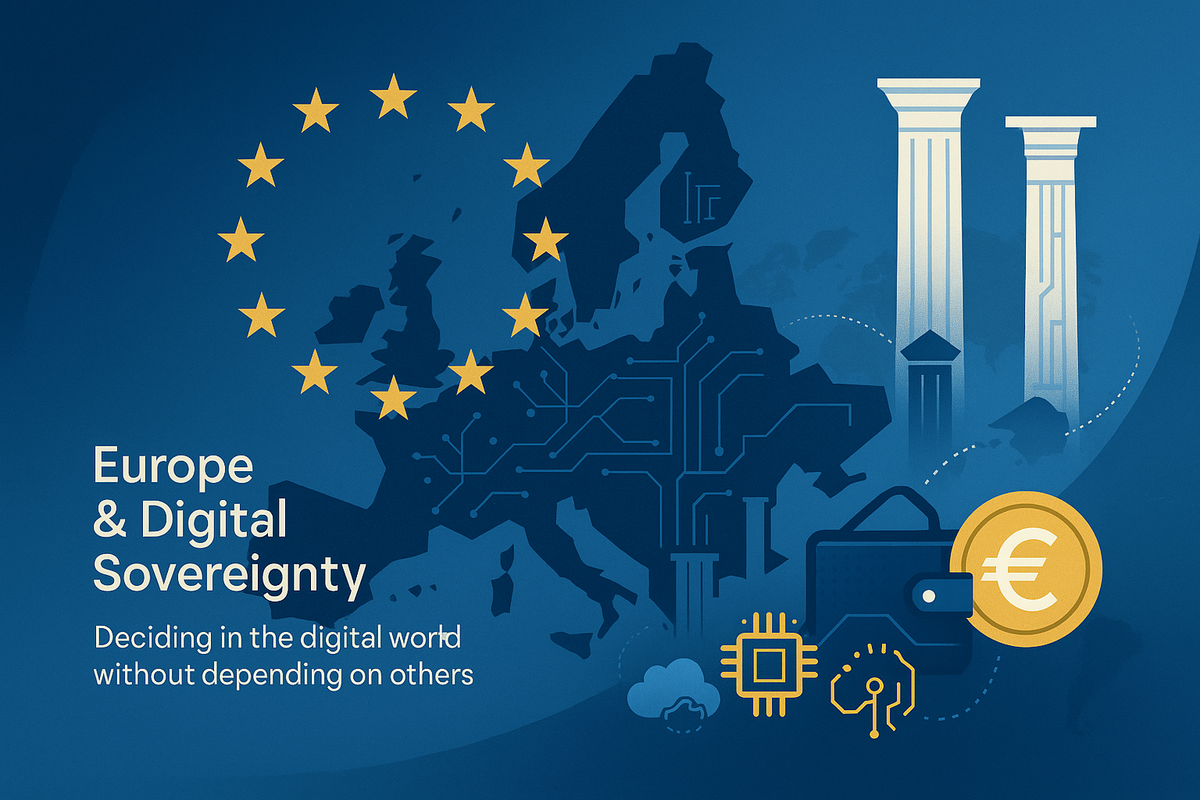
13.5.3 | Digital Sovereignty: The War of National Connectivity Capabilities
As the economic center of gravity shifts toward connectivity structures, the logic of competition between nations changes accordingly. Traditional sovereignty revolved around:
- Territory;
- Resources;
- Population;
- Military control.
In a connectivity civilization, the true question of sovereignty becomes: Who can define, control, and maintain the connectivity structure? Digital sovereignty is not just a matter of data ownership, but whether a nation possesses:
- The capability to build autonomous connectivity systems;
- The capability to maintain key nodes;
- The capability to regulate the velocity of cross-border connectivity;
- The capability to prevent domestic nodes from being absorbed or locked in by external systems.
In the global connectivity network:
- Nations are no longer merely administrative units;
- They are collections of ultra-large-scale nodes.
Competition between nations essentially evolves into a competition over connectivity standards, protocols, platforms, algorithms, and infrastructure. This is a long-term war revolving around national-level connectivity capabilities, and its outcome will determine:
- Whether a nation becomes a core node;
- Whether it is passively embedded into the connectivity systems of other nations;
- Or whether it is marginalized into a low-velocity zone.
Future inequality will no longer primarily manifest in "distribution results," but in the power to define the modes of connectivity. When connectivity becomes the economic ontology, connectivity rights become the most fundamental economic power.