14 | The Flood: The Inevitable Conclusion of Human Self-Disorder and God’s "Grace of Reset"
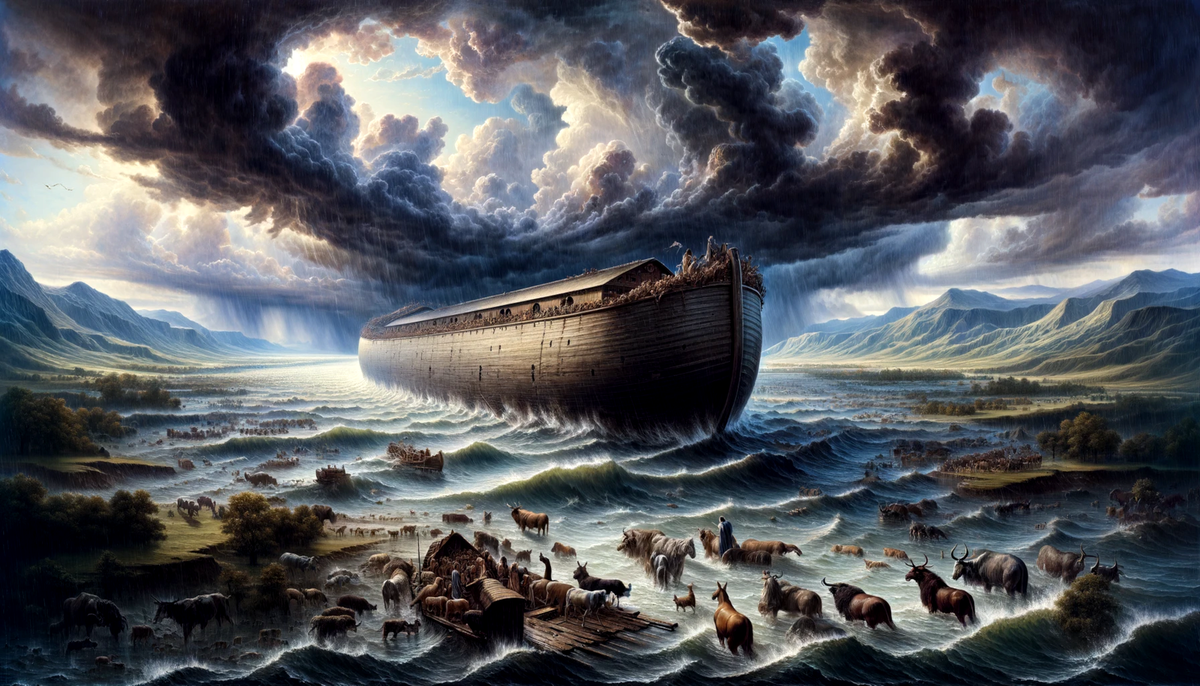
When the Ego expands to the collective level, what becomes of human civilization?
- Beginning with Cain and Abel, violence becomes the structural undertone.
- "The earth was filled with violence" (Genesis 6:11).
- The Biblical conclusion is stark: "Every inclination of the human heart is evil from childhood" (Genesis 8:21).
This is the inevitable outward manifestation of the Self-Structure: Expansion → Oppression → Violence → Total Corruption. Within this context, the Flood is not a tale of capricious anger, but a maximal act of rescue and a "system reset."
I. The Flood as Radical Protection, Not Outburst
The corruption brought by the Ego spreads at an exponential rate:
- Violence incites further violence; hatred breeds deeper hatred.
- Power replicates power; oppression triggers even more cruel subjugation.
- Wickedness spreads through the populace like a relentless virus.
When a civilization enters an irreversible spiral of depravity—where the entire created order is engulfed in violence and the dignity of life is utterly demolished—the intervention of God is not "retribution." It is an act to:
- Halt the infinite diffusion of evil.
- Sever the trend of total collapse.
- Preserve a small remnant of life, yet uncorrupted, as a "Seed."
The Flood was not a random termination; it was the final defensive line drawn so that humanity might still have a future.
II. Cross-Civilizational Memory: Not an Isolated Myth
It is a staggering fact that nearly every major civilization retains a strikingly similar "primordial memory" of a Great Flood:
- The Hebrew Tradition: Noah’s Ark.
- Sumerian / Babylonian: Utnapishtim.
- Greek: Deucalion and Pyrrha.
- Indian: Manu and the Fish-Avatar.
- Chinese: Gun-Yu and the Taming of the Waters.
- Mayan Civilization: The flood that destroyed the "wooden men."
- Numerous Indigenous Cultures: The world submerged by water.
The common elements are persistent: A Divine decree to reset the world; a deluge covering the earth; the destruction of mass life; a chosen few warned to survive; and the world beginning anew through these survivors. This consistency across geography, culture, and language can hardly be dismissed as mere "coincidence." It points to a shared echo of a real historical event within the collective memory of Man.
III. The Post-Flood "Noahic Covenant": The Rainbow as a Sign of Restraint
The Flood was not an ending, but a pivot. God covenanted with Noah: "Never again will I destroy all living creatures by a flood." The Rainbow became the seal of this pledge. This signifies that:
- God’s objective is not the repeated annihilation of humanity through catastrophe.
- The Divine Intent is to find a new mode of governance that balances the protection of the world with the respect for human freedom.
Following the Flood, civilization entered a new phase. Humanity began to establish laws and institutions to restrain violence. City-states, kingship, legal codes, and rituals emerged. Both East and West entered an era of "using external order to suppress internal corruption." This served as the collective preparation for the subsequent Age of the Law.
IV. The Theological Meaning: Departure from God Leads to Self-Destruction
The ontological conclusion of this doctrine is this: The Flood was not God pushing Man toward destruction; it was Man marching toward his own end, with God intervening to prevent "Total Annihilation."
The structural logic follows:
- Emergence of the Self →
- Diffusion of the Dividing Mind →
- Jealousy, Comparison, Violence, and Systematic Oppression →
- Total Corruption of Civilization →
- Acceleration of Human Self-Destruction →
- Divine Intervention: The Flood halts the trend →
- Preservation of Noah’s House as a New Starting Point.
This is not a "Theology of Punishment," but a Theology of Redemption on a civilizational scale. When Man leaves God, the structure of civilization inevitably collapses. God intervenes not to end the world, but to save it.
Summary | Original Doctrine 14
- The Flood was a radical rescue at the moment civilization was poised for self-destruction due to the Ego’s loss of control and the filling of the earth with violence.
- God utilized the Flood to block the infinite spread of wickedness, preserving a remnant as a new beginning.
- The highly consistent flood memories across global civilizations are the outward marks of this Divine action.
- Post-Flood, humanity entered the age of law and institutions, beginning to use external order to temporarily restrain internal depravity.
- The Covenant of the Rainbow proves that God’s ultimate purpose is not destruction, but the preservation and renewal of the created world.
Conclusion: The Flood was not a doomsday, but a protective mechanism. When Man’s departure from God reaches a terminal point, God intervenes so that the world may continue to exist.