58|The Revelation of Manna: Why God Forbids Hoarding and Possession
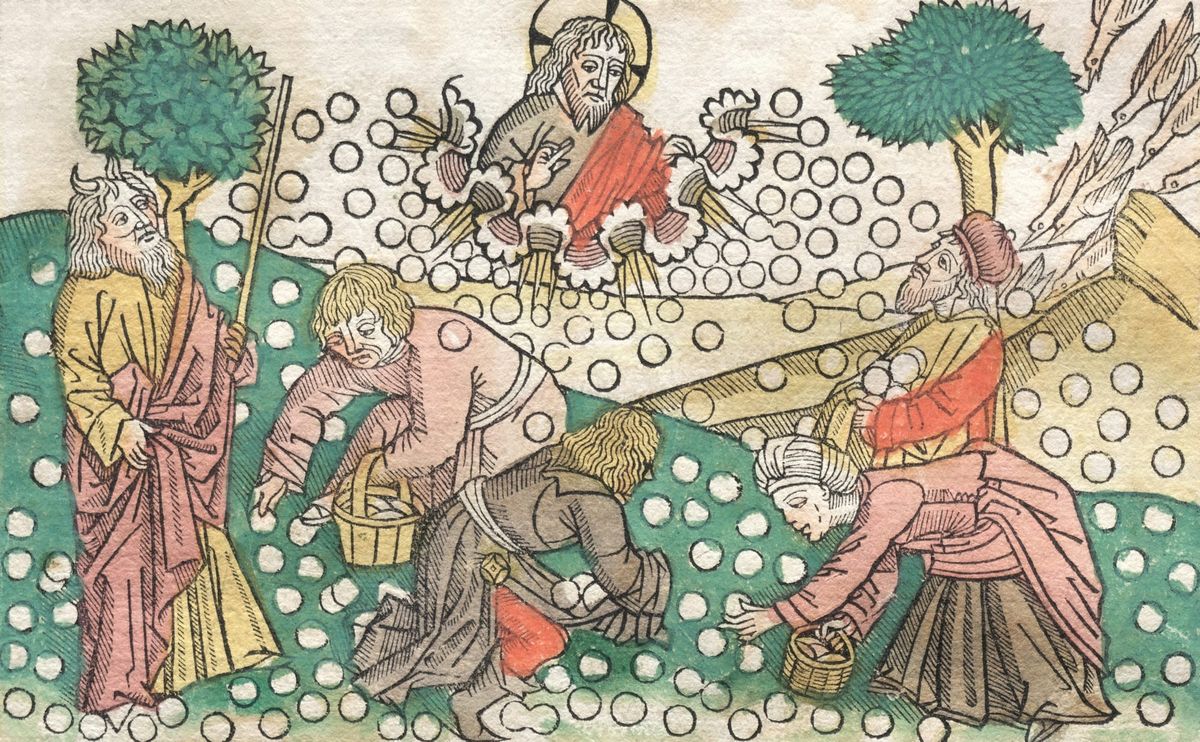
Scripture records: "No one is to keep any of it until morning... but some of them paid no attention to Moses; they kept part of it until morning, and it was full of maggots and began to smell." (Exodus 16:19-20). This is the earliest and clearest lesson in economic theology God gave to humanity: hoarding corrupts life, and possession corrupts the soul. The story of Manna declares: Abundance comes from trust; corruption comes from possession.
This article aims to explain:
- Why humanity is the only species that hoards infinitely;
- How hoarding and possession stem from the "dividing mind" of original sin;
- Why God teaches us through Manna to live in the provision of the present, rather than in self-created fear.
(1) Hoarding Stems from Original Sin: Self → Dividing Mind → Illusion of Scarcity → Desire for Possession
Humanity’s problem has never been insufficient supply, but the dividing mind within: "I must have more than others"; "The more I possess, the safer I am"; "The more I occupy, the more value I have." This is the consequence of eating the fruit of knowledge: man began to define value through comparison and prove himself through possession. Thus, scarcity is not a resource problem, but an illusion manufactured by the human Ego.
(2) The Animal World Has Only Two Modes, and Humanity is the Sole Exception
We can observe animal patterns through biology:
- Most animals do not store; they use what is available in the present. They do not fear the distant future, nor do they care about superiority or ranking; their rhythm of life aligns with the natural rhythm set by God.
- Even those that do store (like squirrels) do so only for necessary cycles, such as winter. They do not store beyond what is required for survival, nor do they store to the point of causing others to starve.
Only humanity is the exception: infinite storage; infinite possession; infinite fear of loss; infinite comparison of who has more. This is not wisdom, but the external manifestation of original sin within the psychological structure.
(3) Why is Hoarding a Sin? Because It Inevitably Manufactures Fear, Scarcity, and Greed
Regarding Manna, Scripture records: "It was full of maggots and began to smell." This is a powerful spiritual symbol: the grace bestowed by God, once clutched and turned into "possession," will rot. Hoarding inevitably brings:
- A sense of scarcity (the more one has, the more one fears it is not enough);
- Greed (the feeling of always lacking a little more);
- Fear (the feeling that others want to steal it);
- The heart of comparison (I must have more than others);
- Social inequality and oppression. Humanity’s suffering is not because grain is insufficient, but because some would rather let granaries rot than open the doors. The story of Manna exposes the structural sin of "possessivism" in human civilization.
(4) Why Does God Forbid Hoarding? Because He Wants Us to Live in the "Rhythm of Trust"
The provision of Manna contains three layers of theological meaning:
- Gathering only one day's portion: God provides daily; there is no need for stockpiling. This is the rhythm of the Kingdom: relying on God rather than on reserves.
- Gathering extra only before the Sabbath: This is for a rhythm, not for fear. This "lawful extra" is similar to animals preparing for winter—following the rhythm of life rather than the urge for possession.
- The rotting of Manna as a spiritual warning: Excessive storage = lack of faith in God’s abundance. Rotting is not just a natural phenomenon, but a sign from God: when grace is hoarded, it turns foul.
(5) Abundance Comes from Trust, Not Control
God does not want us to be a "species that constructs scarcity out of fear," but a "people who flow with abundance through faith." Hoarding and possession are the starting points of all scarcity, fear, and greed in the human world. The story of Manna says:
- Abundance comes from trust;
- Corruption comes from possession;
- God’s provision is always enough;
- The true enemy is not a lack of grain, but fear. Man must break through the dividing mind and the desire for possession to return to the order of abundance set by God.
Summary|Original Doctrine 58
- Human hoarding stems from the dividing mind, not from real need.
- God teaches through Manna: Abundance comes from trust, not from stockpiling.
- Possession corrupts grace; trust keeps the provision flowing.
- Scarcity is manufactured by humanity; abundance is the original reality of God’s creation.
- The story of Manna is God’s fundamental negation of possessivism, hoarding, and fear.
In one sentence: Manna teaches us that as long as we trust God, the present is always enough; possession only makes abundance rot.