A New Civilization Manifesto
A New Civilization
Manifesto
The window is closing. The old authorities are leaving the stage. The new protocol must be built now.
The Window Is Closing
What we are living through is not an ordinary historical turning point. This is a species-level fork in the road.
The signs are clear enough. A pandemic dismantled global supply chains in a matter of months — and with them, the illusion of the old order's stability. The climate system is failing at a pace that outstrips even the most pessimistic scientific projections. Earth's magnetic field is quietly shifting. Global conflict and competition continue to intensify, while no existing governance framework can mount an effective response. And simultaneously, artificial intelligence, quantum computing, and new energy technologies are rewriting the basic equations of production at exponential speed — not over decades, but within the next ten years.
These are not isolated crises. They are the same thing: a civilization running on an old operating system, being burst open by the new processing power it has created.
The garments of the old authorities are being torn away. Political authority, economic authority, cultural dominance — every symbol once used to sustain order is losing its luster one by one. Some holders of wealth and power are accelerating their accumulation; some are quietly retreating; some are beginning to express a confusion they have never before admitted publicly. This is not the crisis of a few individuals. It is the crash warning of an entire operating system.
The early sensors have already felt it. Silicon Valley's tech billionaires are buying farms in New Zealand, building bunkers, funding interstellar migration programs — they believe the continuation of human civilization requires a new Noah's Ark. Princeton doctoral graduates are writing papers on systemic risk and finding no exit. Entrepreneurs in Tokyo, Seoul, and Johannesburg are seeking inner breakthroughs in meditation retreats. The global wellness and spirituality movement is expanding faster than at any point in history, because countless people have felt a fundamental hollowness in the noise of the old system. The Pope laments that the world has fallen into the hands of a few tyrants — yet cannot find a solution. ESG capital tries to patch the old system; the green standards are quietly dissolved by the possessive-model KPIs that underlie every corporate evaluation. Philanthropic institutions pour tens of billions of dollars into the world and find the structural roots of inequality entirely unmoved — because flow released voluntarily by one node, in a network whose protocol has not changed, is simply absorbed by another.
Everyone can see the problem. No one has found a unified answer.
This is why we are writing this manifesto.
Not because we have all the answers. But because the decade following the pandemic is a critical window of transformation. Windows do not stay open forever. Either the tension accumulated by new technology running on the old system leads to systemic collapse — or we complete the operating system update before the collapse arrives.
This is the most dangerous moment. It is also the most hopeful.
Because only after the authority of the old system has sufficiently failed does a new protocol have the chance to be heard. That moment is now.
The True Nature of Wealth
The old civilization told us: wealth is stuff. Whoever possesses more is wealthier. The entire society's incentive mechanisms, legal structures, and educational systems were built on this definition.
That definition was effective in an age of scarcity. But it was never the complete truth.
Wealth is not stuff. Wealth is connection.
Water in a desert is a resource, not wealth. Wealth only emerges when that water connects with someone who needs it. A car sitting in a garage is an asset; when it connects fifty users, it creates fifty times the wealth experience. A social platform produces nothing physical yet creates enormous civilizational value — because it connected people to people.
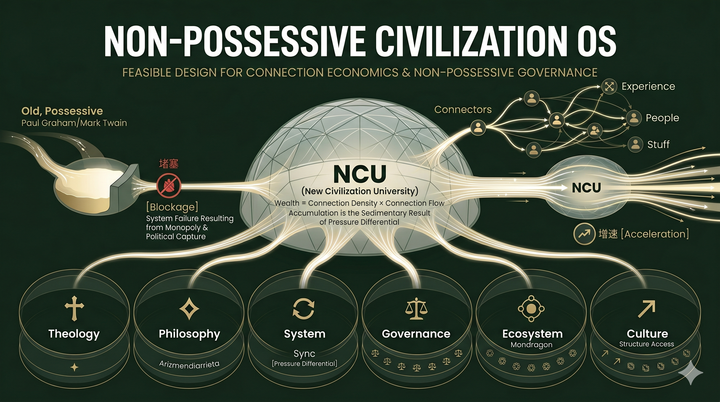
Wealth = Connection Density × Flow Velocity
This is not a metaphor. It is a precise description of the mechanism by which wealth is generated.
It follows that possessing "things" produces diminishing marginal returns, while building "connections" generates nonlinear systemic gains. The more a node accumulates without flowing, the smaller its contribution to the system — and the deeper its own isolation.
Every genius of the old civilization hovered at the edge of this insight. Adam Smith saw that exchange creates value, but locked the observation inside the framework of things. Marx saw labor being extracted, but directed his anger at class rather than mechanism. Paul Graham saw that leverage creates wealth, but never asked: what does leverage actually mean at a deeper level?
Leverage is the self-driving capacity of connection. The less friction, the more self-propelled the connection, the greater the wealth creation. This is the same insight expressed in the language of systems.
The Pathology of Blockage
If wealth comes from flow velocity, then what is poverty? What is crisis? What is civilizational decline?
The answer is a single word: blockage.
When a node's inflow persistently exceeds its outflow, and the accumulation crosses the threshold the system can absorb, it transforms from a facilitator of connection into an obstacle to flow. Like a river naturally depositing sand at a bend — moderate sediment is the inevitable result of fluid dynamics, a legitimate retention. But when the sandbar grows too large, the river changes course, and the flood comes.
This is not a moral indictment. It is a precise description from systems pathology. Monopoly is not the choice of "bad people" — it is the physical result of flow concentrating naturally in a protocol vacuum. Political capture is not the accidental product of "corruption" — it is the systemic inevitability of the rule-making apparatus being internalized once a super-node's flow velocity is large enough.
Marx saw the tumor, but prescribed the wrong cure — excise the tumor while simultaneously excising the organism's growth mechanism. Every revolution in history eliminated old blockages while creating new ones, because revolutions changed the rules without updating the protocol.
Rules are enforced by external force. Protocols are adopted through internal recognition. These are two entirely different things. Failing to see this distinction is the deepest blind spot of every reform effort in the old civilization.
The Protocol Vacuum and Democracy's Dilemma
The old civilization believed: if institutions are designed well enough, civilization will function. Constitutions, rule of law, markets, democracy — these are the most refined products of human reason, won through centuries of blood and thought.
We honor all of that. We must also speak the truth we see: institutions are applications. Faith consensus is the operating system. Without an operating system, applications cannot run.
In any network, nodes must share a common protocol to exchange flow. TCP/IP is not a moral requirement — it is a technical necessity. Economic systems are no different: in a protocol vacuum, flow naturally concentrates at the highest-velocity node, and super-nodes form structurally. When a super-node is large enough, it captures the rule-making apparatus itself. This is not conspiracy. It is the physical destiny of a network without an operating system.
When no universal protocol exists, people do not remain in a neutral, protocol-free state. They fall back to the most primitive available defaults: shared bloodline, shared ethnicity, shared cultural memory. These are genetic and memetic defaults — the operating system the human nervous system runs when no higher-order consensus has been installed. They create local coherence, but generate friction at every boundary. Countless isolated local networks replace the open unified system, and the cost of inter-network conflict erodes total flow velocity at accelerating speed.
Populism is not the mistaken choice of certain people. It is the political expression of a protocol vacuum.
When universal consensus fails, the simplest primitive protocol fills the space: find an enemy, describe the threat, promise salvation. This is precisely the default mode the human nervous system evolved on the savanna — rapid judgment, linear action, us or them.
Democratic institutions assume citizens can make complex judgments. But in a protocol vacuum, simpler narratives naturally win more votes. The institution itself cannot resist this dynamic — because the operating system it requires is already absent.
Every attempt in history to solve civilization's problems through institutions alone has eventually encountered the same failure: the institution is captured from within by the super-nodes generated by the protocol vacuum. The missing variable has always been the layer beneath the institution — shared faith as civilization's operating system.
Stewardship, Not Ownership
We are not the enemies of the old civilization.
We must state this with complete clarity — because the easiest mistake is to read this manifesto as another declaration of struggle. Possession is not evil. It was a protocol that played an enormous role in its era, a necessary mechanism that gave nodes their addresses, activated markets, and drove civilization's accumulation. Without it, nothing humanity has built would exist.
What we declare is not the abolition of possession, but the clear articulation of a distinction the possessive protocol never adequately expressed: the difference between Stewardship and Ownership.
God gave humanity stewardship of the world — not ownership of it. The manager of a river does not own the river; he is responsible for its flow. The guardian of a forest does not own the trees; he is accountable for the forest's health across generations.
This shift happens at the level of individual consciousness, and also at the level of institutional design. We do not rely on anyone's perpetual awakening — people change, and wealth corrodes conviction. We encode this distinction into charters, write it into law, embed it into governance structures, so that it can operate without depending on any individual's virtue.
How a New Protocol Spreads
We will not spread this protocol through revolution.
Revolution is only the violent metabolic clearing that occurs after a system's self-renewal has failed. It eliminates old blockages while creating new ones in the act of clearing. Not one revolution in history has truly solved what it claimed to solve — because it changed the rules without updating the protocol.
We walk a different path — the path every successful protocol has walked.
HTTP did not spread by government mandate. It spread because every node that adopted it discovered its connections multiplied and its flow velocity increased. When enough nodes joined, the cost of remaining outside exceeded the cost of joining, and the protocol became the universal standard. Not conquest. The victory of demonstration.
Stage one: new people carry the new protocol. Every system update must begin with new carriers. Young people cultivated through our New Civilization University, formed by the belief system before wealth has had time to corrode them, accept the governance constitution and build market-leading enterprises in their sectors. Any system renewal must use new people — people are the core of every movement, every reform.
Stage two: let the results speak. Non-possession produces greater flow. Returning profits to employees and consumers increases inflow. The founder discovers that what he gave up was never truly his. Faith is vindicated not by argument but by outcome.
Stage three: faith spreads through benefit, not doctrine. Jesus gave Peter the fish; Peter then believed. We do not preach the faith first and then invite people into our enterprises. We help people through genuine products and services — and the faith travels with the benefit, becoming quietly the new operating system, the foundational guarantee of everything that follows.
Stage four: the protocol becomes the self-evidently optimal choice. Joining produces more flow than staying outside. The majority adopt the protocol, and through the experience of actual benefit, deepen their faith. That faith becomes the new operating system — reinforcing the entire new structure from below, generating wisdom that emerges from consensus, ensuring the system continues renewing itself until the next era calls for the next update.
This is the path of the new civilization. Not proclamation, not compulsion, not revolution. Demonstration. The fish first. A protocol that makes joining more advantageous than staying outside — until it becomes the civilization's new operating standard.
The Age of AI and the Purpose of Human Life
People ask: when artificial intelligence does most of the work, what do humans do?
The question itself is the last cry of an old operating system's definition of human value.
Under the possessive operating system, work serves two functions: survival and social positioning. You work to eat. You work to establish your place in the hierarchy. Both functions are mediated by accumulation. If AI eliminates most such work, the old system says: catastrophe. But the old system has always defined the purpose of human life as accumulating the means of survival. That was never the actual purpose of human life — it was the constraint imposed by scarcity.
Here is the deeper truth: the entire arc of human technological development has been accumulating toward a single threshold — the moment when we no longer need to work for survival. Agriculture liberated us from full-time hunting. Industrialization liberated us from full-time farming. Digitization liberated us from vast categories of repetitive labor. The arrival of AI is the final step of this liberation. The question is not "what will people do when AI takes their jobs?" The question is: what were people always meant to do, once the survival constraint was lifted?
Every person is born with what we call a Purpose — something they are constitutionally made to do, explore, create, or experience. These things have always existed within people, but have been suppressed by the survival constraint. Most people have spent most of their lives doing work that was not their Purpose, because they had no choice.
The zero marginal cost society, running on the right operating system, makes a different arrangement possible: every person pursues their Purpose, and the invisible hand — not the market's invisible hand, but the ordering principle built into creation — coordinates those Purposes toward system-level optimality.
This is what we mean by the Kingdom on earth. Not a religious program. Not a utopia imposed by ideology. A civilization that has finally built enough productive capacity to let people become what they actually are — and trusts that when they do, the system finds its own optimal state.
The danger is not that AI is too powerful. The danger is that an extraordinarily powerful technology is being handed to a civilization still running an operating system designed for scarcity. The sword grows larger. The child holding it has not grown up. This is why the operating system update cannot wait.
All who have seen the window of civilizational change,
all who feel anxiety or even dread about the future of the old system,
all who do not want technological acceleration to arrive at the singularity of human extinction,
all who feel the hollowness of meaning inside the mansion,
all who have sought personal breakthrough in the monastery or the meditation retreat and found it not enough,
all who have sensed this turning point in human destiny and not yet found the direction —
Unite.
Not to patch the old system —
patches cannot genuinely take hold in a system whose root structure is unchanged.
Not to pursue only personal awakening while leaving the world behind —
an individual enlightenment that does not become a node in a new protocol
is only a brief bubble in the ocean of the old system.
Not to build an interstellar Noah's Ark for a chosen few —
a vessel that carries only some
is not the continuation of civilization. It is civilization's surrender.
Unite to update the operating system of human civilization.
Wealth is not things — wealth is connection.
Power is not accumulation — power is flow velocity.
Success is not possession — success is stewardship.
Life is not work — life is Purpose.
This is the most dangerous moment.
It is also the most hopeful.
All who are willing to build the new civilization, unite.
What you will lose is only the illusion.
What you will receive is a world in flow.
New Civilization Operating System · Connection Economics · Non-Possessive Governance
This manifesto is a public document of thought. Any node willing to join this protocol is welcome to carry it forward.