You Are Not the Author of Your Success:A response to Paul Graham's "How to Make Wealth

Paul Graham's essay on wealth is one of the most widely read pieces of writing about money and work ever published. It's also built on a premise that stops one level too soon.
His definition is simple: wealth is stuff people want. To create wealth is to make things people want. The more people want what you make, and the faster you can make it, the wealthier you become. It's a clean, intuitive model. And for anyone trying to understand why startups can create enormous value in a short time, it's genuinely useful.
But there's a problem with it. And the problem isn't minor.
Imagine a desert oasis — abundant water, green grass, everything people need to survive. If no one knows it exists, if no paths lead to it, if it appears on no map, what is its value? Zero. Not because the water isn't real. But because value doesn't exist until connection is made between need and what satisfies that need.
Graham says wealth is stuff people want. The more precise statement is:
wealth is the connection between what people want and what satisfies that want. Making the thing is only half the equation. The other half — the half that actually creates value — is the connection.
The warehouse versus the river
This isn't a semantic distinction. It changes everything about how you think about wealth.
If wealth is stuff, then accumulation makes sense. You make things, you store them, you own them. The more you own, the wealthier you are. Graham's model leads naturally here — wealth as a warehouse, measured by what's inside.
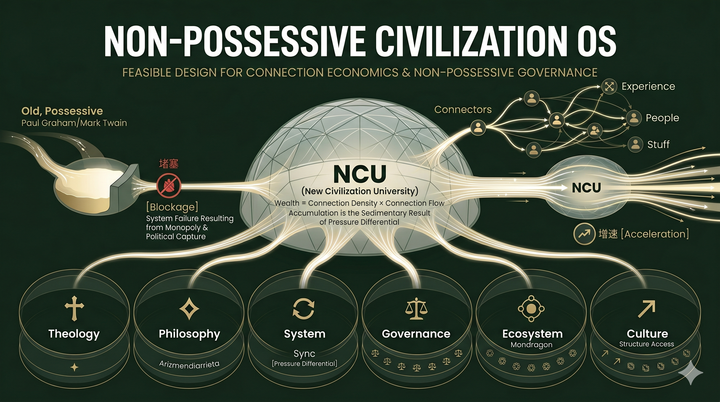
But if wealth is connection, then accumulation is exactly the wrong instinct. A river doesn't become more valuable by being dammed. It becomes less valuable. The dam might make the person who owns it temporarily rich, but it impoverishes the system. The valley downstream dries up. The fish die. The farmers leave.
What actually determines wealth in a connection model? Two things: connection density and flow velocity.
Connection density is how many people your product or service reaches — how many nodes in the network you touch. Flow velocity is how fast value moves: how quickly your product reaches the people who need it, how often they return, how rapidly their needs evolve and you evolve with them.
By this measure, the wealthiest entities aren't the ones with the largest warehouses. They're the ones through which the most value flows the fastest. Which is why Facebook and Tencent, in their early days, seemed to produce nothing — no obvious product, no clear technology — and yet became enormously valuable. They weren't making stuff people wanted. They were creating connections that people needed. The value was in the network, not the nodes.
What Graham got right, and where he stopped
Graham's insight about leverage is correct as far as it goes. If you've created something people want, leverage — technology, management, distribution — amplifies how many people you can reach and how fast. More leverage, more wealth.
But here's what he doesn't follow through on. In a functioning system, every successful company has both a product people want and some form of leverage. So why do some companies generate vastly more wealth than others, even when their technology and management are comparable? And why do some companies generate enormous wealth without an obvious product at all?
The answer isn't better leverage. It's that they've positioned themselves as connectors rather than producers. They don't make the thing — they make the connection between the thing and the person who needs it. And in a networked world, connectors capture more value than producers, because the connection is scarcer than the content.
Graham's leverage model describes how to amplify output within a system. It doesn't describe how the system itself works, or what happens when leverage accumulates in too few places.
Why most startups die — and what the connection model explains
About seventy percent of startups fail because they build something nobody wants. Not because the product was badly made. Often it was made with tremendous care and skill. They failed because they optimized for the node — the product itself — without asking whether a connection existed to be made.
Graham would say he already addressed this — make stuff people want, not stuff you want to make. But that formulation has an epistemological trap. Almost every founder who spent two years building something nobody wanted genuinely believed they were building something people wanted. "Stuff people want" gives you no method for verifying that belief before you build. It tells you what the target is. It doesn't tell you how to avoid fooling yourself about whether you've hit it.
The connection model provides that method. Ask first whether the connection exists, then ask how to build the bridge. Not "will people want this" — a question founders almost always answer with hope rather than judgment — but "does this connection exist right now, and if not, what is preventing it from forming." That question can be answered before you build anything. It doesn't require you to predict demand. It requires you to observe gaps. The tragedy of the founder who emerges after two years with something excellent that the market doesn't need becomes, from this starting point, largely avoidable.
Starting from connection means starting from the market, not the product. It means asking first: where is a connection missing? Where do people have a need that nothing is currently reaching? Your product is not the thing you make — it's the bridge you build. The bridge only has value if there's something on both sides worth connecting.
This reframes what a startup actually is. Not a node trying to attract other nodes. A connector identifying an unserved gap in the network and positioning itself there. The question shifts from "how good is our product" to "how necessary is this connection." A mediocre product that connects something genuinely unconnected will outperform an excellent product that duplicates an existing connection every time.
Leverage is friction reduction, not force multiplication
Graham's concept of leverage — technology, management, better processes — is usually read as force multiplication. More leverage means more output from the same input. Hire better people, build better systems, scale faster.
But this framing leads founders toward a particular kind of mistake: believing that the path to growth is building a better organization. Hire the best MBA. Implement the right management framework. Optimize the engineering team. This advice is not wrong exactly, but it misidentifies what leverage actually does in a connection model.
In a connection model, leverage isn't force multiplication. It's friction reduction. The question isn't "how do we amplify our output" but "what is preventing connections from forming, and how do we remove that resistance."
This reframing opens up the leverage toolkit considerably. There are at least three distinct ways to reduce connection friction:
The first is reach — better information tools that let your connection find the people who need it. This is what distribution and marketing actually are: not persuasion, but reduction of the distance between need and what satisfies it.
The second is density — finding markets where the connections are underserved. Not competing for existing connections but identifying gaps where large numbers of people have needs that nothing currently reaches. The less contested the gap, the less friction you need to overcome.
The third — and most powerful — is self-connection. Products that generate their own connections. When someone uses the product, the product automatically connects to more people. Each connection replicates itself. This is what people call virality, but the mechanism is deeper than it sounds: the product is not just connecting people to a service, it is itself a connection that creates more connections. WhatsApp doesn't grow because WhatsApp markets itself. It grows because every user who joins automatically becomes a reason for the next user to join. The connection is the product.
Early-stage startups that grow without management or process are almost always doing one of these three things — usually the third. They're not outperforming on the node. They've positioned themselves at a gap where connections form almost automatically. Graham reads this as exceptional product-market fit. The connection model explains why: they found a place in the network where the demand for connection was so strong that friction almost didn't matter.
When the dam breaks
Here's what a pure accumulation model eventually produces. A small number of nodes, through leverage and compounding, capture an ever-larger share of the network's resources. They don't just own more — they control the connections themselves. At a certain point, the network stops flowing. New entrants can't connect. Innovation slows. The system that produced the wealth begins to consume it.
This isn't speculation. It's what happens to every system where accumulation is the primary goal and flow is the secondary concern. The Roman latifundia. The European feudal system. And, increasingly, the platform economy — where a handful of companies own the connections between everyone else, extracting rent from every transaction that passes through them.
Graham is teaching people how to catch the most fish in the river. What he's not asking is what happens to the river when too many fish are caught and stored rather than returned to the system.
Stewardship versus ownership
The alternative isn't communism or redistribution. It's a different conception of what ownership is for.
If wealth is connection and flow, then ownership should serve flow. Assets held in ways that maximize their circulation create more wealth than assets held in ways that maximize their accumulation. This isn't moral argument — it's systems logic. A landlord who leaves buildings empty to preserve asset value is destroying network value. A platform that charges rent on every connection is gradually strangling the network it depends on.
There's an old idea that captures this better than most economic frameworks: stewardship. The steward doesn't own the asset — they're responsible for it. Their measure of success isn't how much they've accumulated but how well the asset has been maintained and how productively it has flowed through the system during their tenure.
The biblical concept of Jubilee — the periodic return of land to its original condition, the cancellation of debts — is usually read as a religious or ethical requirement. But it's also an economic mechanism: a built-in correction to prevent the kind of accumulation that eventually blocks flow and collapses the system.
Graham's model has no Jubilee. It has no correction mechanism. It optimizes for individual wealth creation without asking what happens to the system when everyone optimizes for individual wealth creation simultaneously.
The deeper reason to think in connections, not nodes
Everything above is about how to succeed. But there's a more important reason to adopt the connection model — what it does to you after you succeed.
When a founder believes their success came from building a great product and finding the right leverage, they are making an attribution error. They are mistaking their position in the system for their own capability. The product was great, yes. The leverage worked, yes. But what actually produced the outcome was the gap in the network that was waiting to be filled — the unmet connection that already existed before they arrived. They found it and built the bridge. That matters enormously. But it's not the same as having created the value from nothing.
This attribution error has three serious consequences.
The first is the serial founder problem. Companies that dominated one era routinely fail in the next — not because they lack resources or talent, but because their founders concluded the wrong lessons from their first success. They believe the method worked. So they apply the method again, in a new context where the network gaps are different, where the connections that need to be made are different. They optimize the node when they should be reading the network. The attribution error makes them systematically blind to the thing that actually mattered.
The second is rigidity. Founders who believe their success came from specific leverage — a particular technology, a management approach, a distribution strategy — become attached to that leverage. They apply it with increasing sophistication. They hire people who reinforce it. They build organizations around it. And then the network shifts, the old connections saturate, new gaps open elsewhere, and they cannot move. Their logic traps them: that leverage worked before, therefore it should work again. But leverage is only valuable relative to the friction that exists in the current network. When the network changes, the leverage that reduced friction yesterday may create it tomorrow.
The third consequence is the hardest to see, and the most important. A founder who believes they are the protagonist of their own success story — who measures their worth by what they built and accumulated — will resist the natural lifecycle of the connections they created. Every bridge eventually becomes a dam. Every connector that captures enough value eventually starts blocking the flow it once enabled. The platform that connected buyers and sellers starts extracting rent. The technology that opened access starts controlling it. This is not inevitable by nature. It is inevitable by mindset — when the founder cannot distinguish between their contribution to the system and their ownership of it.
The connection model produces a different mindset, almost automatically. If you understand that your profit came from improving connection efficiency — that the value you captured was proportional to the value you created for others — then a particular kind of humility becomes not a virtue to cultivate but a logical conclusion. You were not the author of the value. You were the bridge through which it flowed. The bridge matters. But the river was already there.
This humility is not weakness. It is the most practically useful orientation a founder can have. It means that when your bridge becomes a dam — when your position in the network shifts from enabling flow to blocking it — you can see it clearly, accept it without existential crisis, and move. Find the new gap. Build the new bridge. The internal peace this produces is not separate from the external effectiveness. They are the same thing.
And for the system as a whole, a generation of founders who think this way is worth more than any policy or regulation. Not because they are more virtuous, but because they are more accurate. They see what they actually are — temporary connectors in a network that will outlast them — and they act accordingly.
Graham is teaching people to be better fishermen. That's genuinely useful. If you're trying to build a startup, his framework will help you think more clearly about what you're doing and why some approaches work better than others.
But the framework assumes a healthy river. It doesn't ask whether the river is healthy. It doesn't notice when the fishing is getting worse year by year because too many fish are being caught and stored rather than returned. It has no concept of the river itself as something that requires maintenance.
Wealth is not stuff people want. Wealth is the capacity of a system to connect people with what they need, sustained over time. The entrepreneur who understands this doesn't just ask "what can I make that people want." They ask "what connections am I enabling, what connections am I blocking, and what happens to the system if everyone does what I'm doing."
That's a harder question. It doesn't have a clean answer. But it's the question that determines whether the river keeps flowing.
— A response to Paul Graham's "How to Make Wealth"