Belief is a primary force
Most people think productivity is about resources. More capital, better technology, smarter people. They're not wrong. But they're describing symptoms, not causes.
Marx said productive forces determine social relations. Deng Xiaoping said science and technology are the primary productive force. Both observations are true. But they stop one level too soon.
Start from first principles. Technology doesn't appear from nowhere — it comes from people. But not all people produce technology. Most don't. And the ones who do aren't uniformly distributed across intelligence or background or access to resources. So what actually separates them?
Think about an ancient army. Set aside weapons, since in ancient warfare the two sides were usually similarly equipped. What made one army defeat another twice its size? It wasn't tactics alone. It was what happened when casualties hit twenty percent.
The twenty percent problem
Most armies in Chinese history collapsed at twenty percent losses. Not because they ran out of soldiers, but because something inside the unit broke — the invisible structure that made individual men act as one. Once it broke, the retreating soldiers became more dangerous than the enemy. A rout is worse than a battle.
Zeng Guofan understood this. The Xiang Army recruited by hometown — not for logistics, but because a soldier fights harder when the man next to him is his cousin. Grief and rage are better motivators than pay.
The Communist Army took this further. With shared ideology, you didn't need kinship. Units held past eighty percent casualties. Some fought to the last man. This isn't a military curiosity. It's a data point about what humans are capable of when the binding force is strong enough.
What startups actually die from
I've watched hundreds of startups fail. After a while you stop seeing them as business failures and start seeing them as social failures. The product wasn't the problem. The market wasn't the problem. The team stopped being a team.
About sixty to seventy percent die from internal conflict — equity disputes, power struggles, diverging visions, the slow accumulation of unspoken grievance until someone finally leaves. Another ten or fifteen percent simply stop. Not because they hit an insurmountable obstacle, but because the people involved decided it wasn't worth continuing.
Subtract those two causes and almost nothing is left. Technical problems, market problems, funding problems — these are real, but they're solvable by a team that refuses to quit. The founders who succeed aren't the ones who avoid hard problems. They're the ones who keep going after the problems arrive.
Shi Yuzhu once told a room of founders: stop trying to predict your difficulties. It won't help. Most of the problems you'll face, you can't see from here.
He's right. And this is the key insight. If you can't predict the problems, then what you're actually selecting for isn't problem-solving ability. It's the disposition to keep solving problems regardless of what they turn out to be.
Belief versus calculation
People use the word "belief" loosely. But most of what gets called belief is actually calculation. "I believe this company will succeed" usually means "I've estimated the odds and they look good." That's not belief. That's a bet. When the odds shift, the bet changes.
Real belief is defined by its unconditional quality. You know someone truly believes something when they hold it even when it costs them. A soldier who fights when winning is easy isn't demonstrating belief. A soldier who fights when losing is demonstrating something else entirely.
The same is true in any creative endeavor. A founder who keeps building when funding is flowing isn't demonstrating belief. A founder who keeps building when the money is gone, the co-founder quit, and the market looks hostile — that person is showing something that has no better name than belief.
Jack Ma once said to an investor who had just committed capital: when you first met me, you thought I was a crazy guy. But when you came to Hangzhou, you found a hundred people just as crazy. That's what convinced them. Not the business plan. The density of belief.
An objection worth taking seriously
Here's the obvious counterargument: cults have belief. Pyramid schemes have belief. Hong Xiuquan had belief, and the Taiping Heavenly Kingdom ended in massacre. If belief is the primary productive force, it can clearly also be a destructive one.
This is true. But it proves something different from what it seems to prove. It doesn't show that belief doesn't matter. It shows that the object of belief determines the direction of the force.
The distinction is what the belief points toward. Belief centered on the self — "I believe I will win," "I believe my judgment is superior" — is still a form of calculation, just one that bets on the ego rather than the odds. It's strong in good times. But when the self is fundamentally threatened, it either collapses or hardens into paranoia. Hong Xiuquan's refusal to tolerate any dissent in his final years is what this structure looks like at its extreme.
Genuine belief points toward something beyond the self — something worth completing even if you don't survive to see it. This has a structural advantage: it doesn't depend on personal victory to sustain itself. Failure attacks the self, but it can't destroy the thing. Which is why this kind of belief holds under pressure in a way that ego-based conviction doesn't.
So belief is a primary force — that much is clear. The question was never whether to have belief. It's what your belief is pointed at. Fire is a primary form of energy. Whether it burns your house down or cooks your food is a question of use, not of fire itself.
Why this matters for investors
Most venture capital selection runs on a simple heuristic: past performance predicts future performance. Good school, previous exit, domain expertise, strong network. These aren't useless signals. But they all measure performance under normal conditions.
The problem is that startups aren't normal conditions. They are, almost by definition, a sequence of novel crises. The skills that got someone to a comfortable professional position — pattern recognition, risk management, knowing when to cut losses — are often exactly the wrong skills for founding a company. Knowing when to cut losses will kill a startup if applied too readily.
What you actually want to know is: what does this person do when their previous advantages stop working? Because they will stop working. Every founder eventually hits a wall that their background, network, and intelligence can't get through. What happens next is entirely a function of something that doesn't appear on a resume.
The signals worth reading are behavioral, not biographical. How does this person respond to failure — not failure in the abstract, but their own specific failures? When someone close to them betrayed them, did they become more controlling, or did they reflect and rebuild? Do they seem to be moving toward something, or away from something? There's a difference, and it matters enormously for endurance.
The oldest example
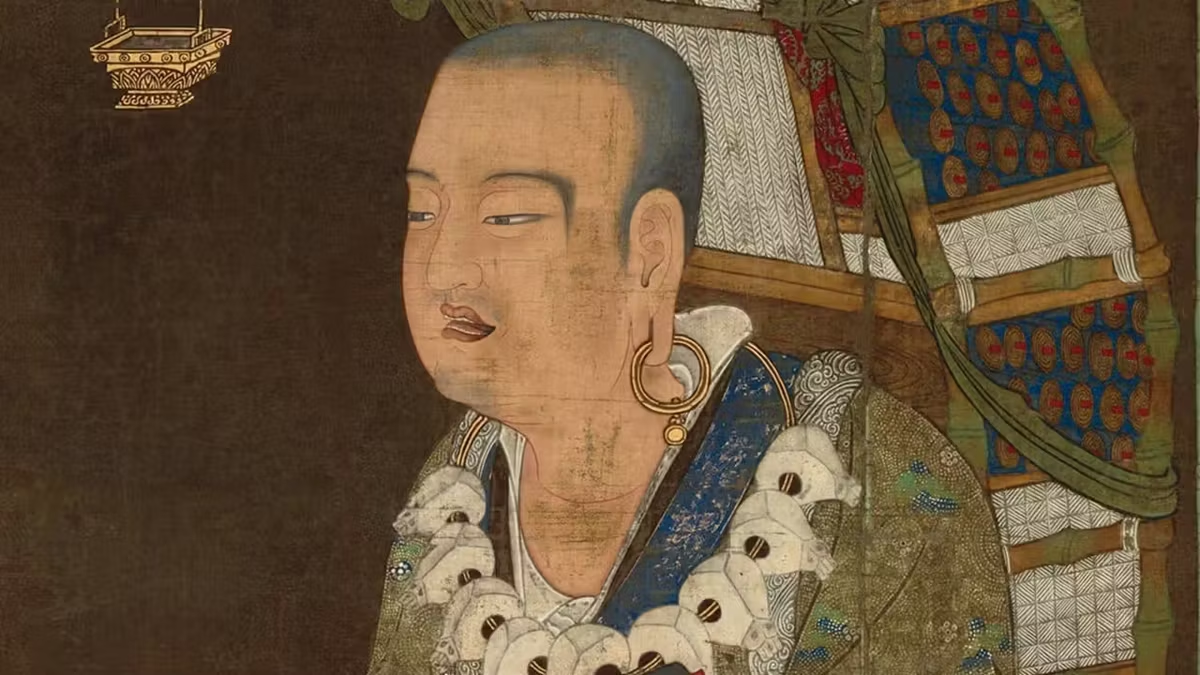
Xuanzang's journey to India is, at its core, a startup story. One person, without institutional backing, traveling through territories he'd never mapped, facing problems he couldn't have anticipated. Sand seas. Hostile kingdoms. The endless accumulation of small failures that make up any long journey.
He made it not because he was the most credentialed monk in the Tang dynasty. He made it because at the beginning, he had already decided: return with the sutras, or die trying. That prior commitment changed the nature of every subsequent decision. There was no longer a question of whether to continue. Only how.
This is what belief actually does. It doesn't solve problems. It removes the option of not solving them. And that removal, paradoxically, makes solving them more likely.
The real unit of productive force
Technology is productive force. So are capital, talent, and infrastructure. But all of these require a prior condition: someone who will not stop.
Without that condition, technology sits unused, capital dissipates, talent disperses. The history of failed ventures is largely a history of adequate resources and insufficient commitment. Not insufficient intelligence, not insufficient opportunity — insufficient will to continue when continuing became hard.
The unit of productive force, at the bottom, is not a tool or a skill or even a person. It's a person who has committed to something beyond their own comfort — and then found others who have made the same commitment. That combination, and almost nothing else, is what makes things actually get built.