New Civilization OS Strategic Q&A(1)
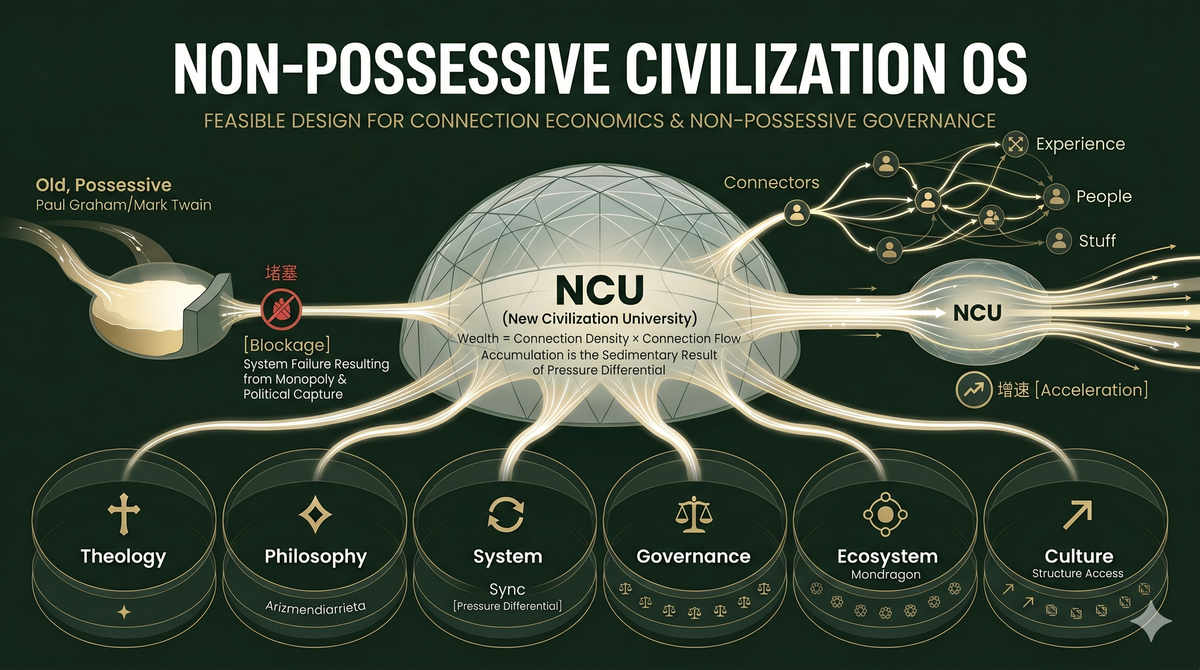
Non-Possessive Civilization OS
Strategic Q&A
From the Essence of Wealth to Corporate Governance, System Dynamics to Theology—A Self-Consistent Scheme for Civilizational Building
PG equates wealth to "stuff," which doesn't go deep enough. The essence of wealth is Connection—the relationship established between those with use value and those in need.
Resources alone are not wealth. Water in a desert is a resource, but if no one knows it's there, it creates zero wealth. Only when the water connects with people who need it does wealth emerge.
Therefore: Connection itself *is* wealth. Social platforms don't produce goods, yet they create immense wealth—by connecting people to people. Tourism connects people to experiences. Logistics is the connection service between people and stuff.
Wealth = Connection Density × Connection Flow
Acceptable, but requires a deeper look. Whether stuff you create has value depends on whether it strengthens the connection between people and experiences, or between people and other people.
A sofa connects mats, wood, and the weary human body needing rest into a rational form. Marketing is the art of connecting people to people. Product design is reducing the connection friction between people and function.
So the underlying logic of "creating stuff people want" is: What position do you occupy in the entire connection system, and what connection gain do you provide.
Possessing "stuff" leads to diminishing marginal utility, but establishing "connections" generates non-linear system gains. One car used by fifty people creates fifty times the wealth experience—this isn't dividing the cake; it's the same cake generating fifty times the value.
PG’s leverage is a linear amplifier—your decision affects more people, the leverage is greater. I redefine it as: The self-driven nature of connection, i.e., the reciprocal of the friction coefficient.
The smaller the friction, the more self-driven the connection, the greater the leverage:
• Standardized products reduce cognitive friction
• Network marketing achieves batch connection
• Viral spread is the extreme case of fully self-driven connection
But here’s a dynamic PG completely omits: Once a node becomes a blockage, it will be bypassed. Wealth cannot be "held" long-term—holding is blockage, blockage damages overall flow, and flow reduction eventually反噬s the node itself.
Accumulation is the natural sedimentation of Flow Pressure Differentials, not the result of possession.
Like a river naturally accumulating sand at a bend—sand isn’t "possessed"; it’s the inevitable result of fluid dynamics. Because a node increases system flow, inflow naturally exceeds outflow, and this difference is profit.
This explanation is deeper than PG’s possession theory because it clarifies the source of legitimacy for accumulated wealth: Not "I created it, so I own it," but "I accelerated the system, so the system naturally deposits wealth with me."
But if accumulation becomes excessive and the node blocks, the system *must* bypass it—this isn’t a moral judgment; it’s fluid dynamics.
Monopoly + political capture are the system's tumors.
Normal cell: increases local flow, takes nutrients, gives back to the system. Tumor cell: consumes frantically, doesn't give back flow, eventually blocks the whole.
Tumor characteristics: don't bring flow gains to the body, but still grow frantically. Eventually, the body dies, and the cancer cells die.
This isn't a moral warning. It's a systemic inevitability: Monopoly capital eventually damages its own foundation for survival. When a blockage cannot be bypassed, the system only has one road left: violent metabolism. All revolutions in history are expressions of this mechanism.
Core Propositions of Flow Theory
| Dimension | Paul Graham | Karl Marx | Connection Economics |
|---|---|---|---|
| Wealth Essence | Stuff People Want | Congealed Labor | Connection Density×Flow |
| Accumulation Source | Creation+Possession | Surplus Value Exploitation | Pressure Differential Sedimentation |
| Distribution Issue | Market-Solved | Revolution-Solved | Systemic Self-Adjustment (bypass blockage) |
| System Failure | Market Failure | Class Conflict Escalation | Clot/Tumor—Node Blocking Total Flow |
| Resolution Mechanism | Competition+Innovation | Abolish Private Property | Maintain Node Purity, Non-Possessive Design |
| Level of Analysis | Describing Phenomena | Moral Judgment | Revealing Physiological Mechanisms |
Marx held a PhD, strictly trained classically. He wasn't *unable* to do complex system thinking. But his theoretical framework is inherently linear-binary: find opposing sides, designate victim and victimizer, derive direction for action.
This isn't Marx's limitation—it’s the transmission choice he made, consciously or unconsciously.
The human brain has a basic feature: naturally suited for linear, cause-clear, action-direction narrative. This is the legacy of evolution—on the savannah you needed to quickly judge "flee or fight," not probability권权权权权权权权权权.
Marx's genius was packaging the narrative structure most people naturally understand in academic language. This wasn't deception; it was precise adaptation to the human nervous system's default settings.
Democracy’s design premise is that citizens make rational judgments, but the human nervous system’s default mode is emotion-priority, cause-simplification, linear-action.
When these two meet, the result is often not that citizen education raises cognitive quality, but that political competition lowers the narrative threshold—because simpler narratives win more votes.
This is populism's structural advantage: it precisely provides the format most comfortable to the human brain. Find scapegoats, depict threat, promise salvation.
The deeper problem: when consensus is missing, democracy might speed up toward authority. When people feel lost, unsafe, and lacking meaning, they instinctively seek the order sense offered by authority structures. History has shown democratic election produce leader who terminate democracy.
Marx describes symptoms, PG describes phenomena, I try to describe the physiological mechanism itself. The real problem isn't how to distribute wealth, but why systems generate blockages and how to prevent them at the institutional level.
Truly stable civilization requires something deeper as a foundation—a common Belief Consensus.
I like the OS analogy. Systems are applications, Belief Consensus is the OS. Applications cannot run without an OS. Democracy, law rule, market—these are applications; their operation relies on a deeper consensus: human dignity is real, integrity has value, others’ pain deserves attention, the future deserves responsibility.
Wisdom emerges from consensus nodes, not simply aggregated from individual rationality. When enough people share a deep value orientation, the group possesses a certain collective intelligence. This isn’t mysticism; it’s a basic feature of complex systems.
Yes. Puritans left England not to possess more, but for a belief consensus—to build a "City on a Hill" in the new world. This spiritual core generated overwhelming economic advantage:
• Trust cost extremely low (shared belief reduces trade friction)
• Collaboration density extremely high (connections self-driven between consensus nodes)
• System expansion speed extremely fast (each node increases flow, not blockage)
Two hundred years later, it became the world's largest economy. Not accidental.
More critical is America's immigrant spirit: not dictating only Mayflower descendants enjoy internal freedom democracy, but structural access, not cultural access. Those accepting this value structure could join. This is the root reason it could continuously absorb immigrants and expand.
Yes. Success produces wealth, wealth produces possession impulse, possession impulse corrodes belief consensus—this is an inherent decay cycle.
So cannot solely rely on belief awakening; must code Belief Consensus into system structure, allowing it to operate without relying on continuous individual awakening. This is precisely the task of system design.
And, possession structure isn't just an economic issue; it’s a misrecognition of the state of existence—equating self boundary with possession boundary. Genes must replicate, memes must spread, self must magnify—these are biological and cultural programs running, not true human choice. Possessors are themselves victims.
Once they knew, no one would choose possession. Because possession is inherently an illusion.
Core principle: Cannot rely on founders remaining awakened forever, because people change. Non-possession must be coded into articles, using legal structure to prevent corrosion. Specific designs include:
Income Constraints: Mandating founder maximum income ceiling, preventing individual accumulation from becoming blocking node.
Profit Distribution: Non-profit structure, profits returned to employee and consumer, not accumulated at capital end.
Consumer Governance: Consumers participate in corporate governance via consumption积分tokens, directly turning use value beneficiaries into governance subjects. Blockage directly damages voting people, preventing node blockage structurally.
Growth Discipline: Expansion speed *must* submit to structural integrity—rather grow slowly than break structure. Every new node enters system *already within* structure; cannot introduce out-of-structure participants for scale.
Traditional non-profits rely on moral consciousness and external supervision. Traditional cooperatives rely on internal democracy, easily limited by cultural boundaries.
My design’s essential difference is: not teaching people to become good, but building a system where good and bad people will exhibit non-possessive behavior—because system structure makes non-possession the economically optimal choice.
Non-possessive nodes, because they don't block, naturally continue having system flow pass through, gaining total long-term flow far greater than possessive nodes’ accumulated stock. This is economic logic, not moral requirement.
Four Constraints of Structure Design
Mondragon Cooperative, Spain, founded 1956 by Father Arizmendiarrieta in Basque region, starting with 5 worker and a small factory. Today, Spain's 7th largest business group, over 80,000 worker-owners.
Key data: Zero worker laid off during 2008 financial crisis—impact absorbed through internal transfer and wage adjustment. Max wage to lowest wage ratio controlled under 6:1 long-term, vs ordinary multinationals often over 300:1.
It has own university, R&D center, bank, forming complete non-possessive ecology. Arizmendiarrieta himself refused any title or ownership—he knew people change, so coded values into articles, not relying on personal virtue.
Quite the opposite. Fagor failure is failure of abandoning non-possessive system under expansion pressure, not failure of non-possessive system itself.
Fagor felt globalization competition speed pressure, started hiring large number non-cooperative member ordinary employee—these people *not* in non-possessive structure, forming internal two-layer system. Using possessive tools against possessive opponents, fighting on opponent's best field, then lost.
This precisely proves: Non-possessive system’s boundary condition is structure *must* cover *all* participants, zero exception. Once possessive system nesting appears, corrosion begins *there*.
Arizmendiarrieta built university because he knew people *must* first be cultured into this before becoming qualified cooperative member. Fagor successors forgot this.
Mondragon’s seventy years of success, and Fagor's failure, tell same story: Non-possessive system wins when adhering to structure, loses when compromising structure. Our design codes this lesson into legal governance layer, making compromise structurally impossible.
Not one, not ten—one hundred, one thousand. Establish a non-possessive head enterprise in *each* niche market.
Single non-possessive node in possessive ocean is vulnerable island, facing continuous competition pressure and talent poaching. But if each niche has non-possessive head, mutually supporting ecological system forms between them, not isolated nodes.
This completely aligns American founding logic: not one person awakening, but enough awakening nodes forming new gravity field, making latecomers naturally attracted entering.
Mondragon limitation is deep root in Basque culture, strong cultural boundary, very hard truly globalize.
Keyphrase is structural access, not cultural access. America, if dictating only Mayflower descendants enjoy internal freedom democracy, other immigrants distinguish treating, would never develop today.
Our design: Anyone, regardless background, can become full participant by joining structure. New enterer isn’t second-class member, but full co-owner. Accept this value structure, can join.
This Non-Possessive YC function: Not training entrepreneurs how to make money, but training how build head enterprise *within* non-possessive structure. Every graduating enterprise is non-possessive node certain niche, while also demonstration and support next batch founder. This is a self-replicating system.
Two Key Designs for Scaling
This isn’t a project plan; it’s complete blueprint for a Civilizational OS. Each layer supports next, from deepest ontology to most concrete structure design.
PG tells entrepreneurs how enter flow; we tell entrepreneurs how *become* flow itself—rather than node blocking it.