4.3 |Section 2 | Perception is Reality
Section 2 | Perception is Reality
"Perception is reality." This statement carries two profound meanings:
First, facts can be created—your beliefs and cognitions will eventually manifest as your tangible reality.
Second, there is no such thing as an "objective fact" in any true sense—every so-called fact is filtered and reconstructed by our brains.
Let us explore these two dimensions.
I. Cognition Creates Fact
We begin with a core principle repeatedly validated in psychology: Humans use action to verify what they already believe. This is confirmed across various scientific fields:
- In Expectancy Theory: People only invest high levels of effort into things they "believe have a chance of success."
- In Schema Theory: Beliefs formed in early life dictate what we perceive and what we ignore.
- In the Self-Fulfilling Prophecy: An individual’s expectation itself drives the world to develop in that specific direction.
In other words, you do not "see the facts and then form a belief." Rather, you take action while carrying a belief, and then use that same belief to interpret the outcome. This is the exact psychological mechanism behind most success systems (such as the Law of Attraction): belief creates not only a psychological state but also the reality of the external conditions.
We assume life operates like this:
Analysis $\to$ Planning $\to$ Execution $\to$ Review
But a real life is closer to this:
A Preset $\to$ Analysis $\to$ Planning $\to$ Execution $\to$ Review
Different presets inevitably lead to entirely different destinies.
II. The Classic Evidence: The Pygmalion Effect
In 1964, American psychologist Robert Rosenthal visited an ordinary elementary school and told the teachers: "We have a brand-new IQ test that can predict which children are about to experience an intellectual 'growth spurt.' The children on this list will show immense progress over the next year."
The teachers believed him completely. Consequently:
- They gave these children more encouragement and patience.
- They spoke to them with a gentler tone and higher expectations.
- They subconsciously transmitted the belief that "you are special."
But the teachers didn't know—the list was random. The children had not taken a special test, nor did they have extraordinary talent. Yet, a year later, the results shocked the world:
- The IQs of these children rose significantly.
- Their classroom performance improved.
- Their self-confidence grew stronger.
- Their social skills became more mature.
The reason was singular: Others believed they would improve, so they began to believe it themselves. And that belief created reality.
The process is:
Teacher’s Belief $\to$ Changed Teacher’s Behavior (Eye contact, tone, patience)
Student’s Belief $\to$ Changed Student’s Action and Effort
Ultimately $\to$ Reality Aligned with Belief
This is the profound insight of the Pygmalion Effect: Results are rooted in belief. Reality automatically aligns with cognition. This is why Henry Ford said: "Whether you think you can, or you think you can't—you're right." Who are you? It depends on who you believe you are. But where does this "belief" come from? This is the focus of our next chapter.
III. No "Objective Facts," Only Facts Filtered by the Brain
The second meaning of "Perception is Reality" is that there are no uninterpreted facts. Every fact must pass through the brain’s filter. Therefore:
- Facing the same event, different people will offer different interpretations.
- The interpretation is the "fact."
- There are as many realities as there are people.
- We do not see the world as it is; we see the world as we are.
The objective world only provides stimuli; "facts" are constructed by our interpretations. In other words, reality is actually a projection of our cognition. The world often responds to us in the exact way we expect it to. This is the true psychological foundation of "Manifesting." There is no such thing as an "unfiltered fact." All our facts are the result of the brain's screening, processing, and reorganization.
Facts are "Partial Truths" Filtered by Cognition and Belief
You must have seen this before:
- In the same company: One person says, "There are so many opportunities here; you can succeed through hard work." Another says, "This place is full of traps; the boss is incompetent and so are the colleagues."
- Facing the same entrepreneurial journey: One concludes, "This was the most important training of my life." Another concludes, "This is proof that I was cheated; I just have bad luck."
- Even facing the same childhood trauma: One interprets it as, "The world is unfair and unsafe; I must be extremely cautious." Another says, "Because of these experiences, I became stronger and learned how to cherish happiness."
The most interesting part is that when these people recall the past, the "events themselves" they narrate are entirely different. It is as if they did not experience the same thing at all.
Bartlett’s Classic Experiment: How Facts are "Rewritten"
Let’s look at one of the most famous studies in cognitive psychology: Frederic Bartlett’s "War of the Ghosts" experiment.
The Process: Bartlett asked subjects to read a North American Indian folk tale. The structure was unfamiliar, the logic was strange, and it was entirely different from the subjects' cultural background. He then asked them to retell the story immediately, a few days later, and several months later.
The results shocked the psychological world. The experiment found that facts are "reconstructed." Subjects gave completely different versions of the same story, all following these patterns:
- Filling in logic: They rewrote irrational parts to fit a narrative more familiar to their own culture.
- Details aligned with expectations: They thought they were "remembering facts," but they were actually "reconstructing facts" to fit their expectations.
- Automatic deletion: Unfamiliar elements, such as specific Indian rituals or motives, were automatically purged.
- Simplification: The story became shorter and more linear over time; all complexity was stripped away.
The core conclusion: Memory is not a recording; it is a construction.
Bartlett proposed the theory of Constructive Memory. Two people look at the same event, but because their beliefs, personalities, and experiences differ, they process "reality" in entirely different ways. Therefore, the reality they ultimately narrate is bound to be different.
Reality is Rewritten by Belief, Further Strengthening the Original Belief
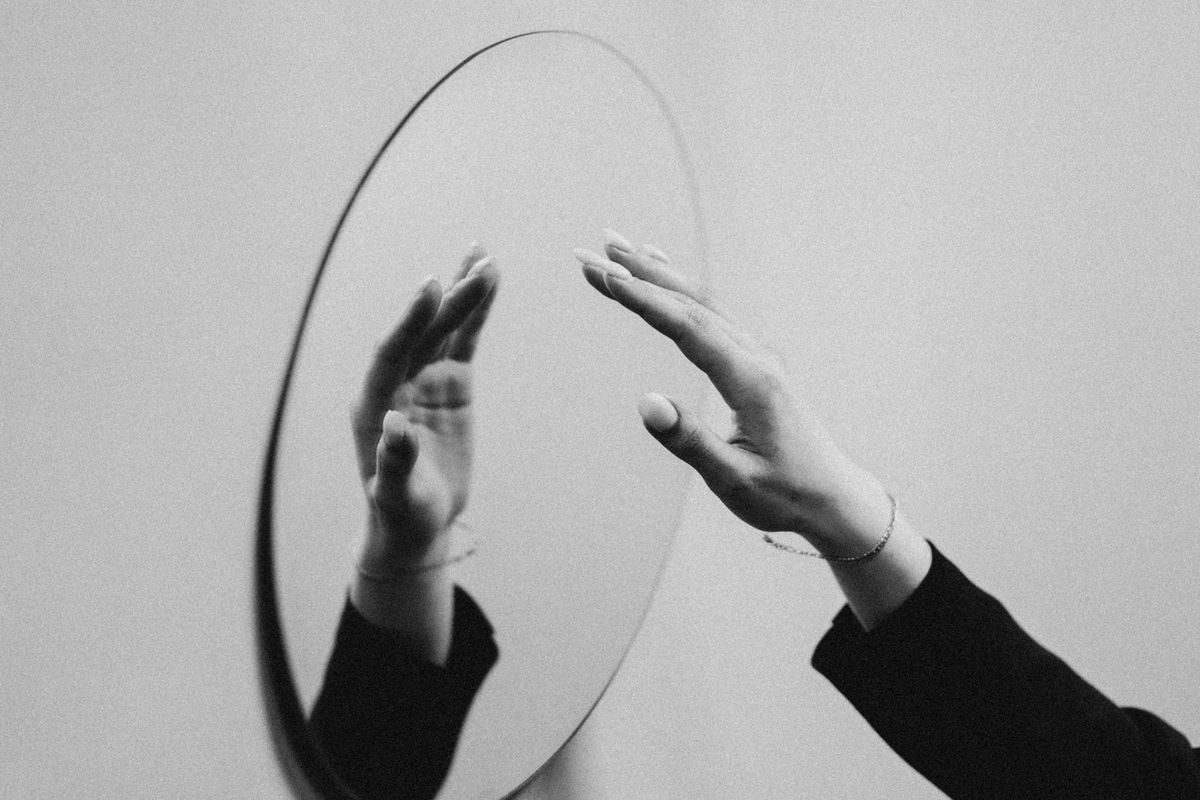
This explains why, even after experiencing many events, people often learn nothing new. Because they do not see the events themselves, but rather a version of the events that has been psychologically filtered. It is like looking into a funhouse mirror—no matter how many times or from what angle you look, the image you see will never be the correct one.
Therefore: The "fact-based decision" does not exist.
We think we are moving from Fact $\to$ Evidence $\to$ Judgment $\to$ Action.
But in reality, the so-called "fact" has already been filtered and interpreted by our beliefs. Since the evidence is processed by belief, any judgment we make based on that evidence is, of course, already predetermined by that belief.
And this law leads directly to the core question of the next section...